
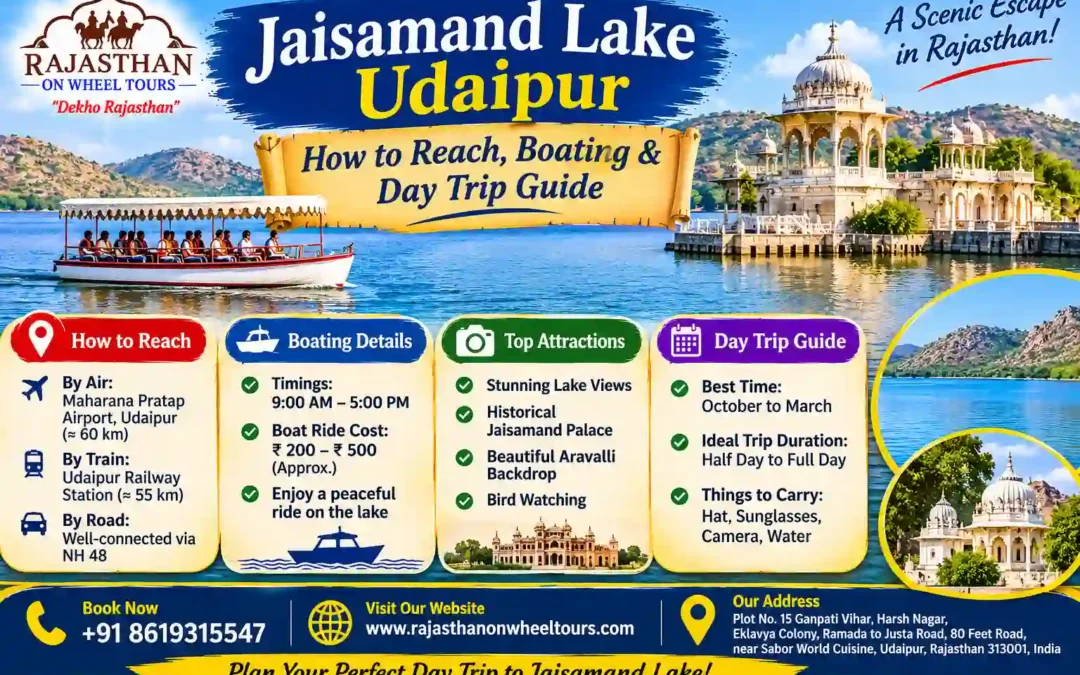
Quick answer: Jaisamand Lake near Udaipur, also called Dhebar Lake, is a huge man-made lake about 50–60 km south-east of the city, roughly 1.5 hours by road. Maharana Jai Singh of Mewar built it in the late 17th century by damming the Gomati river, and it is often called India’s second-largest artificial lake. Visitors come for the marble dam, short boat rides, hilltop palaces and the wildlife sanctuary on its shores. Allow half a day.
This guide covers Jaisamand Lake near Udaipur, in Mewar. A smaller, unrelated Jaisamand Lake near Alwar dates from the early 20th century, so check you have the right one when booking or reading reviews. Most Udaipur visitors never make it here, which is part of the appeal.
Jaisamand Lake at a Glance
| Item | Details |
|---|---|
| Other name | Dhebar Lake |
| Built by | Maharana Jai Singh of Mewar |
| Built | Late 17th century (around 1685–1691) |
| River dammed | Gomati |
| Location | South-east of Udaipur; now in Salumbar district (formerly Udaipur district) |
| Distance from Udaipur | About 50–60 km, roughly 1.5 hours by car |
| Size | About 14 km long; area varies a lot with water level |
| Depth | Up to about 31 m (102 ft) at the deepest point, per most sources |
| Highlights | Marble dam with chhatris, boat rides, Hawa Mahal and Ruthi Rani palaces, wildlife sanctuary |
| Typical hours | Boats and sanctuary roughly 10 AM to 5 PM (check locally) |
| Time needed | 2–3 hours at the lake, plus 3 hours’ return driving |
Entry to the dam area is generally free. The wildlife sanctuary and boat rides charge separate, modest fees per person, with higher rates for foreign nationals. Rates change, so check at the counter.
Where Is Jaisamand Lake Located?
Jaisamand Lake lies in the Aravalli hills south-east of Udaipur, on the road towards Salumbar. Since 2023 it falls in the new Salumbar district, carved out of Udaipur district.
The main visitor point is the dam (bund), where the road arrives. This is where you find the marble steps, chhatris, the Shiva temple, the boat point and parking. The old palaces overlook the lake near the dam, and the sanctuary covers the forested shores.
History: Who Built Jaisamand Lake?
Jaisamand was built by Maharana Jai Singh, who ruled Mewar in the late 17th century. He dammed the Gomati river to create a reservoir for the region, and the lake takes his name: “Jai Samand” is usually translated as the “ocean of victory.” The older name, Dhebar, comes from the area.
Sources give the date as 1685, with the dam inaugurated in 1691. Local tradition says the Maharana gave away gold equal to his own weight in charity at the inauguration.
Is Jaisamand Lake man-made or natural?
It is man-made, formed by the masonry dam across the Gomati valley. Many guides claim it was once the world’s largest artificial lake, which is hard to verify; today it is commonly called India’s second-largest.
How Big and How Deep Is Jaisamand Lake?
The lake is roughly 14 km long, with a winding shoreline. Area figures vary widely between sources, from about 21 to over 80 sq km, because the water spread depends on the monsoon. In good years it overflows the dam; in dry years the edges pull back a long way.
Most sources give a depth of up to about 31 m (102 ft) at the deepest point, near the dam.
There are several islands, with figures of three to seven in different sources. The two largest are usually named Baba ka Magra and Piari. Some islands have small Bhil and Mina settlements, whose families use boats to reach the shore.
What to See at Jaisamand Lake
The marble dam and chhatris
The dam is the heart of the visit. Marble steps lead down to the water, lined with six carved chhatris (cenotaphs) and stone elephants, with a Shiva temple in the middle. Late afternoon light makes it the best spot for photos.
Hawa Mahal and Ruthi Rani ka Mahal
Two old palaces overlook the lake near the dam: Hawa Mahal and Ruthi Rani ka Mahal (the “palace of the sulking queen”). They were built as royal summer retreats. Access can vary, but the view over the lake is the main reward.
Jaisamand Wildlife Sanctuary
The forested hills along the lake form the Jaisamand Wildlife Sanctuary, a former royal hunting reserve. Sources give its area as roughly 52 sq km. Wildlife includes leopard, chital, sambar, chinkara, nilgai, wild boar, striped hyena and jungle cat. Over 200 bird species have been recorded around the lake, and in winter it draws large flocks of coots and migratory geese.
Sightings are a matter of luck; treat it as a forest drive and birdwatching stop, not a Ranthambore-style safari. For a wider view of the state’s reserves, see our wildlife sanctuaries in Rajasthan guide.
Does Jaisamand Lake have crocodiles?
Yes. Mugger (marsh) crocodiles are reported in the lake, along with turtles and many fish species. You are unlikely to see one from the dam, but it is a good reason not to swim or wade, even near the steps.
Boating at Jaisamand Lake
Boat rides leave from the jetty near the dam: usually short motorboat trips of about 20–30 minutes past the islands, with longer rides on request. Boats run in daylight, roughly 10 AM to 5 PM, and may pause in low water or bad weather. Ask for life jackets, especially for children.
For families, a short shared ride is plenty; a private boat suits birdwatchers who want to go further towards the islands. Pay at the official counter, not to touts. For more organised boating, see our Lake Pichola boat ride guide.
How to Reach Jaisamand Lake
| From | Distance (approx.) | Time by road (approx.) |
|---|---|---|
| Udaipur city | 50–60 km | 1.5 hours |
| Udaipur airport (Dabok) | 60–70 km | 1.5–2 hours |
| Salumbar town | About 20 km | 30 minutes |
- By car: The easiest option. A private car lets you stop on the way, wait at the lake and return when you like. Our Udaipur outstation taxi service covers Jaisamand as a half-day or full-day trip.
- By bus: Buses run from Udaipur to Jaisamand, taking about 1.5–2 hours. Services are limited, so check the return times.
Is Jaisamand Lake Worth a Half-Day Trip from Udaipur?
Yes, if you have more than two days in Udaipur and like quiet places. Jaisamand gives you scale and history without crowds, though facilities are few and in a dry year the lake can look shrunken.
A simple half-day plan:
- Leave Udaipur around 1:30–2 PM.
- Reach the dam by 3:30 PM; walk the marble steps and chhatris.
- Take a short boat ride before about 4:30 PM.
- Head to the palace viewpoint above the water.
- Watch the light change over the water and head back before dark.
A morning trip works better for winter birdwatching.
Jaisamand Lake vs Fateh Sagar: Which Is Better for Families?
| Jaisamand Lake | Fateh Sagar Lake | |
|---|---|---|
| Distance | 50–60 km out of the city | In the city |
| Feel | Quiet, rural, vast | Lively promenade, snacks, crowds |
| Boating | Short motorboat rides | Several organised options |
| Extras | Dam, palaces, sanctuary, birds | Nehru Garden island, evening walk |
| Best for | A half-day escape | An easy evening |
For young children, Fateh Sagar is simpler. Choose Jaisamand when you want a change of scene.
Rajsamand or Jaisamand? Rajsamand Lake, north of Udaipur near Kankroli, was built in the 17th century by Maharana Raj Singh and is known for its carved marble Nauchowki. It fits well with a Nathdwara trip. Jaisamand is larger and wilder, in the opposite direction.
Resorts and Food Near Jaisamand Lake
A handful of resorts sit around the lake, including Jaisamand Island Resort, with simpler stays towards Salumbar. An overnight stay gives you sunrise over the water and an early sanctuary visit. Check access roads and recent reviews, as standards vary.
Food at the dam is limited to tea and snack stalls, so carry water and snacks or eat at a resort.
Best Time to Visit Jaisamand Lake
- August to October: After a good monsoon the lake is full and the hills green; Jaisamand at its best.
- November to February: Pleasant weather and the best birdwatching.
- March to June: Hot, with a shrinking water spread. Go early.
Plan Your Jaisamand Lake Trip
We run half-day and full-day trips to Jaisamand from Udaipur. You can book it as an outstation taxi from Udaipur or add it to one of our Udaipur tour packages. For in-city sights, pair it with our Udaipur sightseeing day tour on another day.
Call or WhatsApp +91-8619315547.
Planning more of Rajasthan? Browse all our guides on the Rajasthan Travel Blog.
Frequently Asked Questions
1. Where is Jaisamand Lake located?
Jaisamand Lake is in the Aravalli hills about 50–60 km south-east of Udaipur, on the road towards Salumbar. Since 2023 it falls in the new Salumbar district. Don’t confuse it with the smaller Jaisamand Lake near Alwar, which is a different place.
2. Who built Jaisamand Lake and when?
Maharana Jai Singh of Mewar built it by damming the Gomati river. Most sources date it to 1685, with the dam inaugurated in 1691. The lake is named after him, and “Jaisamand” is usually translated as “ocean of victory.”
3. How deep is Jaisamand Lake?
Most sources put the maximum depth at about 31 m (102 ft), near the dam. Depth and area change a lot with the monsoon, as the lake fills in good rain years and shrinks noticeably in dry years.
4. How big is Jaisamand Lake?
The lake is about 14 km long, with a winding shoreline and several islands. Published area figures range widely, from about 21 sq km to over 80 sq km, because the water spread depends on rainfall. It is commonly called India’s second-largest artificial lake.
5. Are there crocodiles in Jaisamand Lake?
Yes, mugger crocodiles are reported in the lake, along with turtles and fish. Visitors rarely see them from the dam, but you should never swim or wade in the lake, even close to the steps.
6. Is there boating at Jaisamand Lake?
Yes. Short motorboat rides leave from the jetty near the dam, usually in daylight hours, roughly 10 AM to 5 PM. Fees are modest and charged per person. Rides can pause in low water or bad weather, so check on arrival.
7. How much time do I need for Jaisamand Lake?
Plan 2–3 hours at the lake for the dam, a boat ride and the palace viewpoint, plus about 3 hours of return driving from Udaipur. Half a day is enough; add lunch at a resort for a relaxed full day.
8. What else can I do at Jaisamand besides boating?
Walk the marble dam and its chhatris, visit the Shiva temple, take the hill road to Hawa Mahal and Ruthi Rani ka Mahal for views, go birdwatching in winter, or do a forest drive in the Jaisamand Wildlife Sanctuary.
9. Is Jaisamand Lake better than Fateh Sagar for families?
Fateh Sagar is easier with small children because it is in the city, with a promenade and snacks. Jaisamand suits families wanting a quiet half-day outing with boating, history and nature. Many visitors do both on different days.
10. Can I stay overnight at Jaisamand Lake?
Yes. A few resorts sit around the lake, including Jaisamand Island Resort, with simpler options towards Salumbar. Staying gives you sunrise over the water and an early start in the sanctuary. Check recent reviews and access roads before booking.