Quick answer: Rajasthan’s best wildlife sanctuaries and national parks are Ranthambore and Sariska for tigers, Jawai and Jhalana for leopards, Keoladeo (Bharatpur) for birds, the Desert National Park for the Great Indian Bustard, Tal Chhapar for blackbuck, Khichan for demoiselle cranes, and the National Chambal Sanctuary for gharials. Most parks are best from October to March; tiger reserves’ core zones close in the monsoon.
Rajasthan is famous for forts and deserts, but it’s also one of the best wildlife states in India. Within a few hundred kilometres you can track tigers among ruined palaces, watch leopards on granite hills, see thousands of cranes land in a village square, and drive across the Thar in search of one of the world’s rarest birds. This guide lists the parks worth knowing, what each one is best for, and how they fit into a Rajasthan trip.
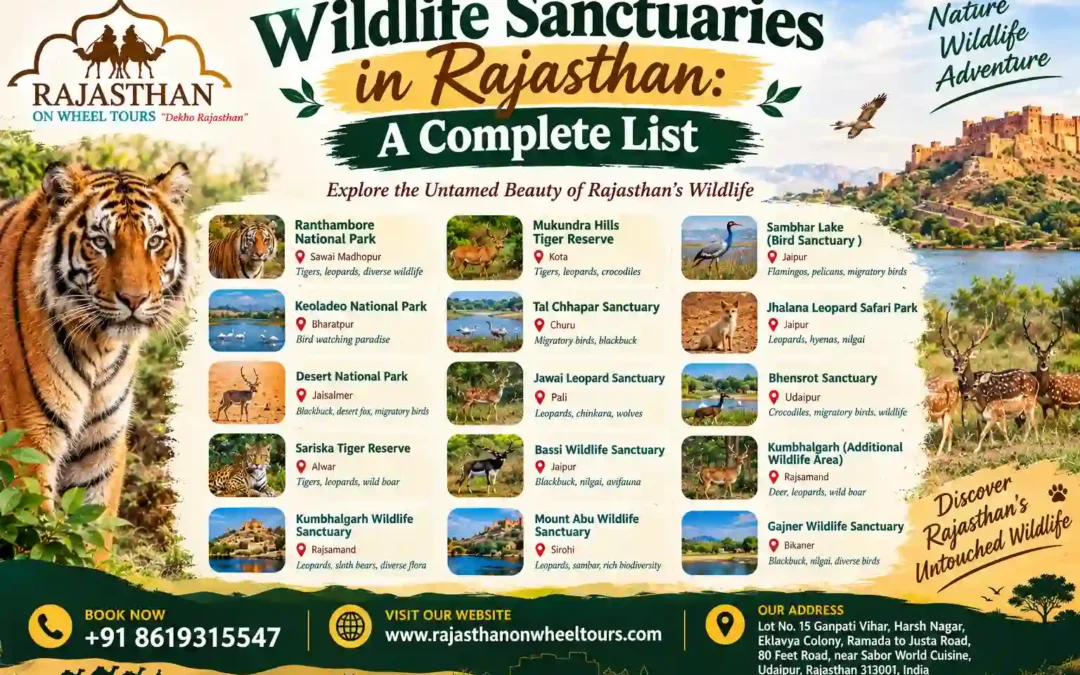
Rajasthan Wildlife at a Glance
| Park | Region | Famous for | Best months |
|---|---|---|---|
| Ranthambore National Park | Sawai Madhopur | Tigers, fort ruins | Oct–Jun |
| Sariska Tiger Reserve | Alwar | Tigers, close to Delhi and Jaipur | Oct–Jun |
| Keoladeo National Park | Bharatpur | Resident and migratory birds | Oct–Mar |
| Jawai | Pali | Leopards in village country | Oct–Mar |
| Jhalana Leopard Reserve | Jaipur city | Leopards on the edge of a city | Oct–Mar |
| Desert National Park | Jaisalmer–Barmer | Great Indian Bustard, desert wildlife | Nov–Feb |
| Tal Chhapar Sanctuary | Churu | Blackbuck, raptors | Sep–Mar |
| Khichan | Near Phalodi | Demoiselle cranes | Sep–Mar |
| National Chambal Sanctuary | Dholpur, Karauli, Kota | Gharials, river dolphins | Oct–Mar |
| Kumbhalgarh Wildlife Sanctuary | Rajsamand–Pali | Forest around the fort | Oct–Mar |
| Mount Abu Wildlife Sanctuary | Sirohi | Hill forest, sloth bears, birds | Oct–Jun |
| Mukundra Hills Tiger Reserve | Kota | Gorges, forest, quiet safaris | Oct–Mar |
| Sitamata Wildlife Sanctuary | Pratapgarh | Teak forest, flying squirrels | Oct–Mar |
| Bishnoi villages | Near Jodhpur | Blackbuck and chinkara near farms | Oct–Mar |
Tiger Country
1. Ranthambore National Park
The best place in Rajasthan, and one of the best in India, to see a wild tiger. The forest is wrapped around a 10th-century fort, with lakes, ruined pavilions and banyan trees that make every sighting look like a painting. Safaris run in Gypsies and Canters across ten zones.
Read our Ranthambore safari booking guide for zones, timings and how to book on the official portal.
2. Sariska Tiger Reserve
In the Aravalli hills near Alwar, about three hours from both Delhi and Jaipur. Sariska lost its tigers to poaching in the early 2000s, and tigers were reintroduced from Ranthambore starting in 2008, one of the first successful tiger relocations in India. The population has grown since.
Sightings are less frequent than at Ranthambore, but the park is quieter and closer to Delhi. Inside are the ruins of the Kankwari Fort, old temples, and the Pandupol temple. It’s a good add-on to a Golden Triangle trip.
3. Mukundra Hills Tiger Reserve
Near Kota, Mukundra protects forested plateaus and the gorges of the Chambal and its tributaries. Tiger numbers are small and sightings rare, but the landscape and the solitude are the draw. It suits travellers who have already done Ranthambore.
Leopard Country
4. Jawai
The leopards of Jawai live among granite boulders, farms and temples, alongside the Rabari herding community. There’s no park gate: safaris are run by local camps, and sighting rates are high. It’s one of the most unusual wildlife experiences in India.
Our Jawai leopard safari guide covers how safaris work, the best season and where to stay.
5. Jhalana Leopard Reserve
A forest on the edge of Jaipur city, home to a healthy leopard population. Short jeep safaris run in the morning and afternoon, and you can be back at your hotel in time for lunch. It’s the easiest leopard safari in Rajasthan, ideal if you only have a spare half-day in Jaipur.
Birding Hotspots
6. Keoladeo National Park (Bharatpur)
A UNESCO World Heritage Site and one of the finest bird sanctuaries in Asia. Created as a duck-hunting reserve for the Maharajas of Bharatpur, it’s now a wetland mosaic home to hundreds of bird species. In winter it fills with migratory ducks, geese, pelicans and storks, alongside resident painted storks, herons and owls.
Vehicles aren’t allowed far inside. You explore by bicycle, cycle-rickshaw (the rickshaw pullers are trained naturalists) or on foot. It’s about an hour from Agra, so it fits neatly between Agra and Jaipur on a Golden Triangle route.
7. Khichan
A village near Phalodi where, every winter, thousands of demoiselle cranes fly in from Central Asia. Villagers have fed the cranes grain for generations, and the birds now land in a feeding enclosure by the hundreds every morning. The sight and sound of the flocks stays with you long after you leave.
Go early in the morning between September and March. It sits on the route between Jodhpur and Jaisalmer, or Bikaner and Jaisalmer.
8. Tal Chhapar Sanctuary
A small, flat grassland in Churu district, known for large herds of blackbuck. In winter it’s also a magnet for raptors: harriers, eagles and falcons hunt over the grass. It’s easiest to combine with Bikaner or the Shekhawati towns.
Desert and River
9. Desert National Park
One of India’s largest protected areas, spread across the Thar around Jaisalmer and Barmer. It’s best known as one of the last homes of the Great Indian Bustard, a critically endangered bird. You may also see chinkara, desert foxes, and winter raptors over the dunes and grasslands.
Visits need a Forest Department permit; go with a local guide in the early morning. See our places to visit in Jaisalmer guide for how it fits a Jaisalmer stay.
10. National Chambal Sanctuary
The Chambal is one of the cleanest large rivers in India, and the sanctuary protects it across Rajasthan, Madhya Pradesh and Uttar Pradesh. Boat safaris show you gharials (the slender-snouted crocodiles found almost nowhere else), mugger crocodiles, river turtles, and occasionally Gangetic river dolphins. Skimmers and other river birds are a bonus. Access from the Rajasthan side is near Dholpur.
Forests of the South
11. Kumbhalgarh Wildlife Sanctuary
The dry forest around Kumbhalgarh Fort, stretching towards Ranakpur. You might see sloth bears, nilgai, chinkara, jungle cats, and with luck a leopard. Jeep safaris run from the fort area, and a long jungle trail links Kumbhalgarh with Ranakpur for keen walkers. Our Kumbhalgarh Fort guide covers the fort and the area.
12. Mount Abu Wildlife Sanctuary
The forested hills around Rajasthan’s only hill station, home to sloth bears, leopards, sambar and a long bird list. Guided morning walks are the best way in. See our Mount Abu page for planning the town itself.
13. Sitamata Wildlife Sanctuary
A remote teak and bamboo forest in Pratapgarh district, south-east of Udaipur. It’s known for flying squirrels, seen at night, and its forest rest houses. Visitor facilities are limited; it suits serious nature lovers.
14. Bishnoi Villages near Jodhpur
Not a formal sanctuary, but some of the easiest wildlife watching in Rajasthan. The Bishnoi community has protected animals and trees for over 500 years, and blackbuck and chinkara graze close to their farms. See our Bishnoi village safari page.
Combining Parks with a Rajasthan Route
Wildlife fits easily into the classic routes:
- Golden Triangle: add Keoladeo between Agra and Jaipur, Jhalana for a half-day in Jaipur, or Sariska on the Delhi–Jaipur leg. Ranthambore needs two nights from Jaipur.
- Southern loop from Udaipur: Kumbhalgarh, Ranakpur and Jawai sit on one route, with Mount Abu at the end.
- Desert circuit: Khichan and the Desert National Park fit between Jodhpur, Bikaner and Jaisalmer; Tal Chhapar fits Bikaner or Shekhawati.
- Jodhpur stay: a morning Bishnoi village safari.
What to Pack for Safaris
- Binoculars, ideally one pair per person
- A camera with a zoom lens (300 mm or more for big cats and birds)
- Neutral-coloured clothes in khaki, olive or brown
- A warm jacket, hat and gloves for winter mornings in open jeeps
- A scarf or buff against dust
- Sunscreen, sunglasses and water
- Original photo ID for parks that need permits
Which Park Should You Choose?
- First wildlife trip, want tigers: Ranthambore.
- Short on time near Delhi: Sariska.
- Only a half-day in Jaipur: Jhalana.
- Leopards and village culture: Jawai.
- Birdwatchers: Keoladeo in winter, plus Khichan and Tal Chhapar.
- Desert lovers: Desert National Park.
- Families with young kids: Keoladeo (by rickshaw) or the Bishnoi villages, both gentle and short.
Safari Etiquette in Brief
Most parks run open-jeep safaris with a guide and driver. Arrive at the gate early with your ID, follow your guide’s instructions, stay seated, and let the guide decide where to stop. Good sightings often come to the quietest vehicles.
Best Time for Wildlife in Rajasthan
- October to March: Best overall, with comfortable weather, winter migrants and open parks.
- April to June: Hot, but often the best tiger and leopard sightings, as animals gather at water.
- July to September: Monsoon. Tiger reserve core zones usually close; birding is quieter.
For the full picture, see our best time to visit Rajasthan guide.
Responsible Wildlife Tips
- Book official permits where they exist, and use licensed guides and vehicles.
- Don’t ask drivers to get closer or go off-route; it’s illegal in protected areas and stresses the animals.
- Keep quiet, skip flash, and don’t feed animals.
- Wear muted colours and carry binoculars.
- Take your litter back with you.
Plan a Wildlife Trip
Our cars cover Rajasthan’s parks from Udaipur and Jaipur. Ranthambore fits a Jaipur stay via our Jaipur to Ranthambore taxi service, and Jawai, Kumbhalgarh and Mount Abu fit a southern loop from Udaipur.
Call or WhatsApp +91-8619315547 (Udaipur) or +91-9983889373 (Jaipur).
Planning more of Rajasthan? Browse all our guides on the Rajasthan Travel Blog.
Frequently Asked Questions
1. Which are the main wildlife sanctuaries in Rajasthan?
The main ones are Ranthambore, Sariska and Mukundra Hills (tigers), Jawai and Jhalana (leopards), Keoladeo (birds), the Desert National Park, Tal Chhapar, Khichan, the National Chambal Sanctuary, Kumbhalgarh, Mount Abu and Sitamata.
2. Which is the best national park in Rajasthan for tigers?
Ranthambore National Park is the best place to see tigers in Rajasthan. Sariska, near Alwar, also has tigers and is closer to Delhi, but sightings are less frequent.
3. Where can I see leopards in Rajasthan?
Jawai, in Pali district, is the most famous leopard destination, with high sighting rates. Jhalana Leopard Reserve, on the edge of Jaipur, offers short leopard safaris close to the city.
4. Why is Keoladeo National Park famous?
Keoladeo, in Bharatpur, is a UNESCO World Heritage Site and one of Asia’s finest bird sanctuaries, with hundreds of resident and migratory species. Visitors explore by bicycle, cycle-rickshaw or on foot.
5. Where can I see demoiselle cranes in Rajasthan?
Khichan village, near Phalodi, hosts thousands of demoiselle cranes every winter, roughly September to March. Villagers feed them each morning, and the cranes gather in huge numbers.
6. What animal is the Desert National Park known for?
The Desert National Park, around Jaisalmer and Barmer, is best known for the critically endangered Great Indian Bustard. Chinkara, desert foxes and many raptors also live there.
7. What is the best time for a wildlife trip to Rajasthan?
October to March is the most comfortable season. April to June is hot but often gives the best tiger and leopard sightings. Tiger reserve core zones usually close during the monsoon.
8. Is Sariska worth visiting?
Yes, especially if you’re near Delhi or Jaipur and want a quieter forest. Tiger sightings are rarer than at Ranthambore, but Sariska’s hills, ruins and birdlife make it rewarding.
9. Can I see wildlife near Jodhpur?
Yes. The Bishnoi villages near Jodhpur have blackbuck and chinkara grazing near farms, and Guda Bishnoi lake attracts demoiselle cranes in winter.
10. Where can I see gharials in Rajasthan?
The National Chambal Sanctuary, accessible near Dholpur, protects gharials. Boat safaris on the Chambal river also show mugger crocodiles, turtles, river birds and sometimes river dolphins.