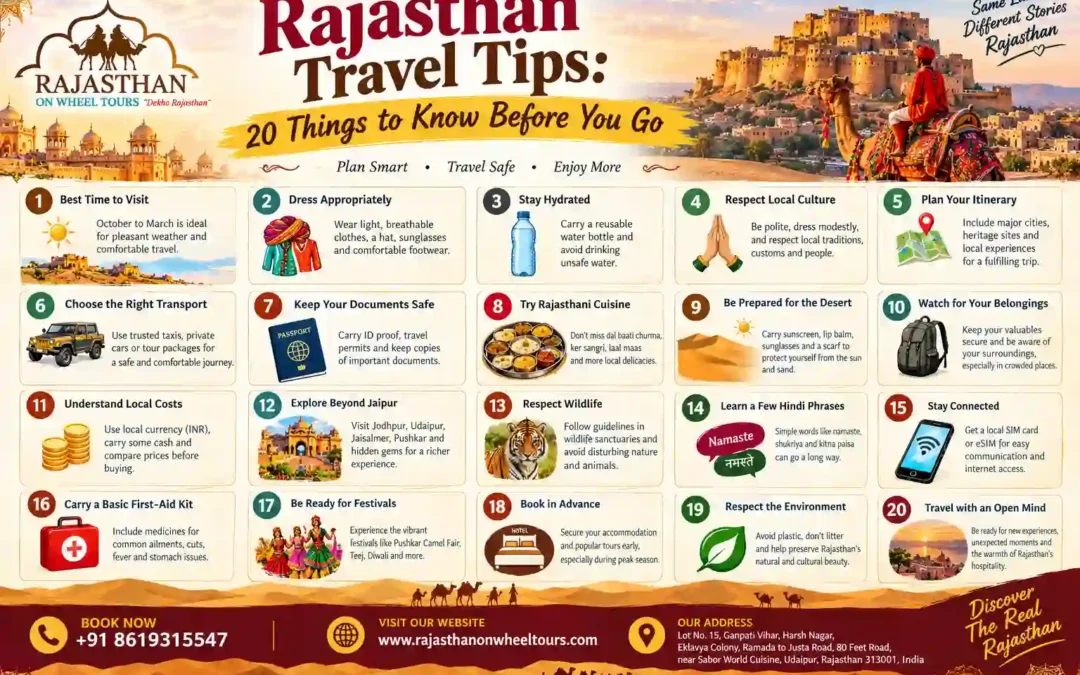
Quick answer: For a first trip to Rajasthan, travel between October and March, allow at least 7 days, hire a car with a driver for intercity travel, start sightseeing early to beat the heat and crowds, dress modestly for temples, carry some cash, bargain in markets, check monument closing days, and don’t try to see the whole state in one trip.
Rajasthan is one of the easiest regions of India to travel in. It’s set up for visitors, its cities are well connected, and its people are famously hospitable. It also rewards a little preparation. These are the 20 things we tell guests before they arrive, from the practical to the small details that make a trip smoother.
Planning
1. Go between October and March
This is the season when days are warm and nights are cool. April to June is extremely hot, and the monsoon (July to September) suits Udaipur and the southern hills more than the desert. Our best time to visit Rajasthan guide breaks it down month by month.
2. Allow at least a week
Rajasthan is India’s largest state. Seven days lets you see three or four places properly; ten to fourteen lets you add the desert or a tiger reserve. A good first-time week is Jaipur, Pushkar, Jodhpur and Udaipur, which we’ve laid out in our 7-day road trip from Delhi.
3. Don’t try to see everything
The most common mistake is a list of eight cities in eight days. Jaisalmer alone is a long drive from anywhere. Choose depth over distance: two nights in fewer places beats one night everywhere.
4. Book ahead for peak weeks
Diwali, Christmas to New Year, and the Pushkar Camel Fair are the busiest times. Popular heritage hotels, trains, safari permits and experienced drivers sell out weeks in advance.
Getting Around
5. Hire a car with a driver for long distances
Trains connect the big cities, but many of Rajasthan’s best places (Ranakpur, Kumbhalgarh, Bishnoi villages, Chittorgarh’s fort interior) are much easier by road. A private car lets you stop where you want. Our guide on how to hire a private taxi in Rajasthan safely explains what to check.
6. Avoid driving at night
Highways are generally good, but trucks, cattle and poor lighting make night driving riskier. Plan driving days to finish before dark.
7. Use autos and app cabs in cities
Inside Jaipur and Udaipur, auto-rickshaws and app cabs are convenient for short hops. Agree the auto fare before you get in if there’s no meter.
8. Expect slow old cities
The old city lanes in Jaipur, Udaipur and Jodhpur are narrow and crowded, and cars often can’t reach your hotel’s door. Pack so you can carry your bag a short distance.
Sightseeing
9. Start early
Forts and palaces are hottest and most crowded from late morning. Arriving at opening time at Amber, Mehrangarh or City Palace gives you cool air, soft light and far fewer people.
10. Check timings and closing days
Several monuments have specific hours or closures. Ranakpur admits non-Jain visitors from around noon; Jain temples in Jaisalmer Fort usually close to visitors by midday; and the Taj Mahal (often added to Rajasthan trips) closes on Fridays. Check before you plan your day.
11. Hire licensed guides
At big monuments, a good guide turns ruins into stories. Licensed guides carry ID cards. Be wary of anyone who approaches you in a car park offering a “special price”.
12. Pace yourself
Climbing forts in the sun is tiring. Build in an afternoon rest, especially from March onwards, and keep one slow day in a week-long trip.
Culture and Dress
13. Dress modestly, especially at temples
Covering shoulders and knees is respectful everywhere and required at many temples. At Jain temples like Ranakpur and Dilwara, leather items (belts, wallets, watch straps) aren’t allowed. Carry a scarf or stole; it doubles as sun and dust protection.
14. Remove shoes at temples and some homes
Look for the pile of shoes at the door. Socks help on hot marble floors.
15. Ask before photographing people
Most people are happy to be photographed, especially if you ask with a smile, but some women and older people prefer not to be. Some temples ban photography inside, and some charge a camera fee.
16. Respect holy towns
Pushkar is strictly vegetarian and alcohol-free, and public displays of affection are frowned upon in conservative areas. Follow local cues.
Money and Shopping
17. Carry some cash
UPI and cards are widely accepted in cities, but you’ll still need cash for small shops, temple donations, tips, parking and roadside stops. ATMs are common in towns but scarcer in rural areas.
18. Bargain in markets, not in fixed-price shops
In bazaars, start at around half the quoted price and settle in the middle. Government emporiums and craft villages have fixed prices. Be careful with gemstones and “antiques”, where overcharging is common, and never let anyone talk you into a gem “export” scheme.
Health and Safety
19. Stay hydrated and eat sensibly
The dry air dehydrates you faster than you notice. Drink bottled or filtered water, carry a bottle in the car, and ease into rich Rajasthani food. Our guide to Rajasthani food has tips on what to eat where.
20. Use normal travel sense
Rajasthan is generally safe for tourists, including solo travellers and families. Use the same care as anywhere: keep valuables secure in crowds, use registered taxis, share your plans with someone, and trust your instincts.
Bonus Tips from the Road
A few smaller things that make a real difference:
- Carry small notes. Change for ₹500 notes is often hard to find at roadside stalls and temples.
- Download offline maps. Signal drops on stretches between towns, especially in the desert and the Aravallis.
- Keep your hotel’s card or address in Hindi. It helps with autos and in old-city lanes.
- Ask before taking a seat at a temple. Some areas are reserved for priests or devotees.
- Plan around festivals. Holi, Diwali and local fairs are wonderful to experience but bring crowds, closures and higher prices.
- Tip sensibly. Drivers, guides, hotel staff and boatmen appreciate it; small amounts are normal.
- Learn a few words. “Namaste” (hello), “dhanyavaad” (thank you) and “kitne ka hai?” (how much is it?) go a long way.
- Take afternoon breaks in summer and spring. Many Rajasthanis do.
- Book evening shows early. The Bagore ki Haveli dance show in Udaipur and fort light-and-sound shows fill up in peak season.
- Keep a light day bag with water, scarf, sunscreen and cash, so you’re never searching the car boot.
How to Plan Your Route
Rajasthan’s sights fall into natural clusters, and planning by cluster cuts down driving time:
- North and east: Jaipur, Shekhawati, Ranthambore, Bharatpur and Alwar. Easy from Delhi and Agra.
- Centre: Ajmer, Pushkar and Bundi. A good bridge between north and south.
- West: Jodhpur, Jaisalmer and Bikaner, the desert circuit.
- South: Udaipur, Kumbhalgarh, Ranakpur, Chittorgarh and Mount Abu, the lakes and hills.
A first trip usually takes one cluster in depth plus one more. Trying to cover all four in a week is what makes trips exhausting.
A First-Timer’s Packing List
- Light cotton clothes with long sleeves and long trousers or skirts
- A warm jacket for winter evenings, desert camps and early safaris
- A scarf or stole
- Comfortable walking shoes that slip on and off easily
- Sunglasses, hat and high-SPF sunscreen
- A refillable water bottle
- Basic medicines (rehydration salts, antacids, motion-sickness tablets)
- A power bank and a universal plug adaptor
- Photocopies or digital copies of your ID
Mistakes First-Timers Make
- Planning too many places. The drive times add up.
- Sightseeing at midday. The heat drains the energy for the evening.
- Skipping the small places. Ranakpur, Bundi and Shekhawati often become trip highlights.
- Booking the cheapest car quote. It usually leaves out tolls, taxes or allowance.
- Not keeping cash. Plenty of places still don’t take cards.
- Missing the evenings. Rajasthan’s sunsets, lake views and rooftop dinners are half the experience.
Travelling with Children or Older Parents
Rajasthan works well for families, with a few adjustments:
- Fewer stops, longer stays. Two nights per place keeps everyone fresher.
- Choose an SUV for long drives; the extra legroom matters on 5-hour days.
- Use vehicles inside big forts. Jeeps go up to Amber Fort, and lifts operate at Mehrangarh.
- Plan child-friendly moments: boat rides on Lake Pichola, the puppet and dance shows, camel rides on the dunes, and the Bishnoi villages’ blackbuck.
- Watch the heat. Keep midday indoors from March onwards.
- Pack snacks and medicines in the car, not the boot.
Respecting Local Life
Rajasthan’s sights are often lived-in places: Jaisalmer Fort has residents, Pushkar’s ghats are sacred, and village tours visit real homes. Ask before entering homes or photographing people, don’t hand out sweets or pens to children in the street (support schools or local charities instead), and keep your voice down in temples. Small courtesies get a warm response.
Is Rajasthan Good for First-Time Visitors to India?
Yes, it’s one of the best places to start. The tourism infrastructure is mature, the distances are manageable by road, English is widely spoken in the tourist trade, and the variety (palaces, deserts, lakes, temples, wildlife) is hard to match. Many first-timers combine it with Delhi and Agra on a Golden Triangle route; see our Golden Triangle tour by car.
Plan Your Trip with Us
We’re a Udaipur-based travel company with a branch in Jaipur. Tell us your dates, interests and how many days you have, and we’ll suggest a route that suits the season and your pace.
Call or WhatsApp +91-8619315547 (Udaipur) or +91-9983889373 (Jaipur).
Planning more of Rajasthan? Browse all our guides on the Rajasthan Travel Blog.
Frequently Asked Questions
1. What should I know before travelling to Rajasthan?
Travel between October and March, allow at least a week, use a car and driver for intercity travel, start sightseeing early, dress modestly for temples, carry some cash, and check monument timings before you go.
2. How many days are enough for Rajasthan?
Seven days is enough for a first trip covering three or four places, such as Jaipur, Pushkar, Jodhpur and Udaipur. Ten to fourteen days lets you add Jaisalmer, Ranthambore or Shekhawati.
3. What is the best way to travel around Rajasthan?
A private car with a driver is the most flexible way, especially for places like Ranakpur and Kumbhalgarh. Trains work well between major cities, and autos or app cabs are good for short city trips.
4. What should I wear in Rajasthan?
Wear light, breathable clothes that cover shoulders and knees, with a scarf for temples and sun. Bring a warm jacket for winter nights, desert camps and early-morning safaris.
5. Is Rajasthan safe for tourists?
Yes, Rajasthan is generally safe for tourists, including families and solo travellers. Take normal precautions: use registered taxis, keep valuables secure in crowds, avoid night driving and share your plans.
6. Do I need cash in Rajasthan?
Yes. Cards and UPI are common in cities, but cash is still needed for small shops, temple donations, tips, parking and rural areas. Keep a moderate amount with you.
7. Should I bargain in Rajasthan?
Bargaining is normal in bazaars and with street vendors. Start around half the quoted price and settle in the middle. Government emporiums and craft villages have fixed prices.
8. What are the common tourist scams in Rajasthan?
The most common are overpriced gems, fake “export” schemes, unrequested shopping stops, and touts claiming a monument is closed. Use licensed guides, registered taxis and fixed-price shops when unsure.
9. Can I visit Rajasthan in summer?
You can, but April to June is extremely hot, often above 42°C. If you travel then, stick to Udaipur and Mount Abu, sightsee early and late, and rest in the afternoons.
10. Is Rajasthan good for a first trip to India?
Yes. Rajasthan has well-developed tourism, manageable distances by road, widely spoken English in the travel trade, and a huge variety of forts, palaces, lakes, deserts and wildlife.