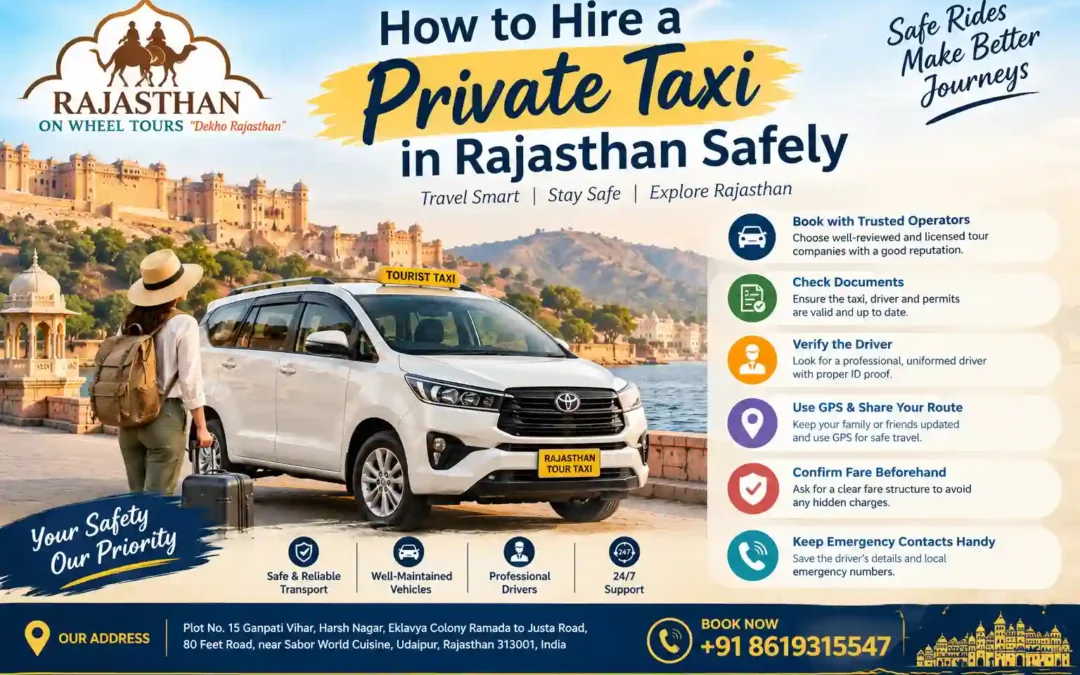
Quick answer: To hire a private taxi in Rajasthan safely, book a commercially registered car (yellow number plate, valid tourist permit) from an operator with a real office and phone number, get a written quote that lists tolls, state taxes, parking and the driver’s allowance, and ask for the driver’s name and number the evening before you travel. Pay a small advance, not the full amount, and agree any shopping stops before the trip starts.
Hiring a car and driver is the most popular way to see Rajasthan, and for good reason. Distances are long, the best places sit between towns, and trains don’t reach Ranakpur, Kumbhalgarh or the Bishnoi villages. Most trips go smoothly. The ones that don’t usually fail on the same handful of avoidable problems: a vague quote, an unregistered car, or a driver who earns more from shops than from driving.
This guide is the checklist we’d give a friend before they book with anyone, including us.
Step 1: Choose Private, Shared or Self-Drive
Start by being clear about which kind of car you actually need.
| Option | How it works | Good for | Watch out for |
|---|---|---|---|
| Private taxi (car + driver) | The car is yours for the trip; the driver follows your plan | Families, multi-day tours, sightseeing with stops | Quote inclusions, driver allowance |
| Shared taxi / shared jeep | You buy a seat; the car leaves when full | Solo budget travel on short local routes | Fixed routes, crowded, no luggage space, waiting time |
| App cab (city ride) | Book a single ride inside a city | Short hops in Jaipur or Udaipur | Patchy availability for outstation trips and in small towns |
| Self-drive rental | You drive yourself | Experienced Indian drivers only | Night driving, cattle on highways, parking in old cities |
Private vs shared, honestly: a shared taxi is cheaper per person and fine for a short hop like Ajmer to Pushkar. For anything with luggage, sightseeing stops or a timetable, a private taxi wins. You leave when you want, stop where you want, and nobody squeezes in beside your bags. For two or more people over a multi-day route, the cost difference per head is often smaller than people expect.
Step 2: Check the Car Is Legally a Taxi
This is the single most important check, and it takes ten seconds.
- Yellow number plate. Commercial vehicles in India carry black text on a yellow plate. A white private plate means the car isn’t registered to carry paying passengers. If something goes wrong, insurance may not cover you.
- Tourist permit. Cars that cross state lines (say, Rajasthan to Gujarat, or a Golden Triangle trip through Uttar Pradesh) need the right permit. An All India Tourist Permit car can travel interstate; a state-only taxi may have to pay entry tax at each border, or may not be able to make the trip.
- Valid papers in the car. Registration, insurance, permit and fitness certificate should be in the vehicle. A good driver will show them without fuss if you ask.
If an operator offers a “cheaper” white-plate car, that’s your sign to walk away.
Step 3: Get a Quote That Lists Everything
Two quotes for the same trip can look very different and end up costing the same, or look the same and end up very different. Ask every operator to confirm these in writing (WhatsApp is fine):
- Car model and seats. “Sedan” can mean anything. Ask for the model, such as Dzire or Etios, Ertiga, or Innova Crysta.
- Kilometres or days included. Is it a fixed package, or a per-km rate with a minimum daily distance?
- Tolls. Included or extra?
- State entry taxes. Relevant if you leave Rajasthan.
- Parking. Monument parking adds up over a week.
- Driver allowance. The daily amount for the driver’s food and stay on multi-day trips. Ask whether it’s included.
- Night charges. Some operators charge extra for driving or waiting late at night.
- One-way return. If your trip ends in a different city, the car has to come back empty, and that’s normally part of the price.
- AC. It should be standard, but confirm, especially in hilly sections where some drivers switch it off.
- Payment terms. Advance amount, balance timing, and accepted methods.
Our own per-km rates and inclusions are published on our Rajasthan taxi service page, and the Udaipur fleet is on our car rental in Udaipur page. Use them as a reference point when you compare quotes, wherever you book.
A very low quote is a warning, not a bargain. It usually means something on the list above has been left out, or the operator plans to make the money back on shopping commissions.
Step 4: Check the Operator Is Real
A few minutes of checking avoids most problems:
- A fixed office address you can see on Google Maps, not just a mobile number.
- Recent reviews that mention named drivers and real routes. Be wary of a page full of five-star reviews posted in the same week.
- A landline or business WhatsApp that answers consistently.
- Clear answers. A good operator explains inclusions without being pushed. Vagueness about tolls or allowance is a red flag.
- No pressure to pay in full. A reasonable advance secures the booking. Paying everything before you’ve met the car leaves you with nothing to fall back on if the car or driver is wrong.
Step 5: Know Who Your Driver Is
Ask for the driver’s name, phone number and car number the evening before your trip. On the day:
- Match the number plate to what you were sent.
- Save the operator’s number separately from the driver’s, so you have someone to call if there’s a problem.
- Share the car number and route with someone at home if you’re travelling alone.
- Agree the plan for the day before you set off: stops, lunch, and rough timings.
Most Rajasthan drivers are professional, careful and proud of their routes. A good driver will suggest the right gate at a fort, the right time to leave for Ranakpur, and the clean dhaba with the good dal. It’s worth building that relationship from day one.
Step 6: Understand the Driver’s Allowance and Stay
On multi-day trips, the driver needs food and a place to sleep. This is normally covered by a daily driver allowance (sometimes called bata). Many hotels in Rajasthan have drivers’ quarters; in others, the driver arranges a dormitory nearby.
If your quote includes the allowance, you don’t pay anything extra. If it doesn’t, it’s paid separately, usually daily or at the end. Either way, agree it up front, and don’t let it become a surprise on the last day.
Tipping is customary but not compulsory. If your driver has been good, a tip at the end of the trip is a fair thank-you.
Step 7: Set Ground Rules on Shopping Stops
This is the issue that sours the most trips. Some drivers and guides earn commission from emporiums, gem shops and textile showrooms, and stop there “on the way” whether you asked or not.
Avoid it simply:
- Say it at the start. “No shopping stops, please, unless we ask.”
- Put it in the booking message to the operator.
- Don’t feel guilty saying no. A professional driver will accept it without fuss.
- If you do want to shop, ask the driver for a place, and compare prices before buying anything expensive. Gems and “antiques” are where the worst overcharging happens.
Safety on the Road
Rajasthan’s highways are generally good, but they have their own hazards.
- Avoid night driving on smaller roads. Trucks without lights, cattle and camels on the road, and tired drivers make night travel riskier.
- Don’t push the schedule. Long days of 8–10 hours behind the wheel are when mistakes happen. Break long routes with an overnight stop.
- Seat belts. Wear them, including in the back. Ask the driver to slow down if you feel unsafe; you’re the customer.
- Winter fog. In late December and January, early mornings on the highway can be foggy. A good driver waits for visibility.
- Hill roads. The ghats into Mount Abu and Kumbhalgarh have hairpin bends. Mention motion sickness in advance.
Scams and Problems to Watch For
- “The fort is closed today.” A classic. Check yourself before agreeing to a detour.
- Unasked guide hand-offs. Your driver “knows a guide” who turns out to be a shop runner. Use licensed guides; they carry ID.
- Changing the car. You booked an Innova and a smaller car turns up. Check the model and plate against your confirmation.
- Extra kilometres. On per-km bookings, note the odometer at the start and end of each day.
- Cash-only “surprise” charges for parking or tolls already in your quote. Keep your quote handy and refer to it.
Booking from Abroad
If you’re booking before you arrive in India:
- Ask for a written itinerary with daily kilometres and hotels.
- Arrange an airport pick-up with a name board, so you aren’t negotiating at the arrivals gate after a long flight.
- Confirm a local contact number that works on WhatsApp.
- Keep a little cash in rupees for tips, small parking fees and roadside snacks.
What a Good Driver Does for You
The right driver is worth more than the right car. On a good trip, your driver will:
- Time the day around the sights, such as reaching Ranakpur at noon or Amber Fort at opening.
- Drop you at the right gate and handle parking, which is the real headache in old cities.
- Know clean food stops on every highway.
- Keep you informed about road works, fog or festival traffic.
- Respect your plan without pushing detours or shops.
If any of these are missing, call the operator early in the trip. A good company will fix it or change the driver.
When a Tour Operator Makes More Sense
A car-and-driver booking gives you the vehicle. A tour operator also books hotels, guides, safari permits and timings. If you’re comfortable booking your own hotels, a car is usually enough. If you’d rather hand over the whole plan, look for an operator who quotes everything transparently, item by item.
How We Do It
We’re a Udaipur-based operator with a branch in Jaipur. Our cars carry tourist permits, our quotes list tolls, taxes and allowance clearly, and we send your driver’s details the evening before. We don’t add shopping stops unless you ask for them. For a route plan, see our 7-day Rajasthan road trip from Delhi, or book a taxi from Udaipur.
Call or WhatsApp +91-8619315547 (Udaipur) or +91-9983889373 (Jaipur).
Planning more of Rajasthan? Browse all our guides on the Rajasthan Travel Blog.
Frequently Asked Questions
1. How do I hire a private taxi in Rajasthan safely?
Book a yellow-plate commercial car with a valid tourist permit from an operator with a real office, get a written quote listing tolls, taxes, parking and driver allowance, pay only a small advance, and confirm the driver’s name and number before the trip.
2. What does a yellow number plate mean in India?
A yellow plate with black text means the vehicle is registered for commercial use and can legally carry paying passengers. A white plate is a private vehicle and shouldn’t be used as a taxi.
3. What is driver allowance in a Rajasthan taxi?
Driver allowance is a daily amount that covers the driver’s food and stay on multi-day trips. Some quotes include it; others charge it separately. Confirm which before you book.
4. Is a private taxi better than a shared taxi in Rajasthan?
For sightseeing, luggage or multi-day trips, yes. A private taxi follows your schedule and stops where you want. Shared taxis are cheaper per seat and fine for short local routes, but they wait to fill up and follow fixed routes.
5. Should I pay the full taxi fare in advance?
No. A reasonable advance to confirm the booking is normal. Pay the balance during or at the end of the trip, as agreed in writing.
6. Do I need to pay for the driver’s hotel in Rajasthan?
Usually not directly. The driver’s stay is covered by the driver allowance, and many hotels have drivers’ rooms. Agree in advance whether the allowance is included in your quote.
7. How do I avoid shopping stops with a taxi driver?
Tell the operator and the driver at the start that you don’t want shopping stops unless you ask. A professional driver will respect that. Put it in your booking message too.
8. Is it safe to travel by taxi at night in Rajasthan?
It’s best avoided on smaller roads, where trucks, cattle and poor lighting increase the risk. Plan driving days to finish before dark, and break long routes with an overnight stop.
9. Can a Rajasthan taxi go to other states?
Yes, if it carries the right permit, such as an All India Tourist Permit. Interstate trips may involve state entry taxes, so confirm whether they’re included in your quote.
10. Should I tip my taxi driver in Rajasthan?
Tipping isn’t compulsory, but it’s customary on multi-day trips if the driver has been helpful and safe. Most travellers tip at the end of the trip.