
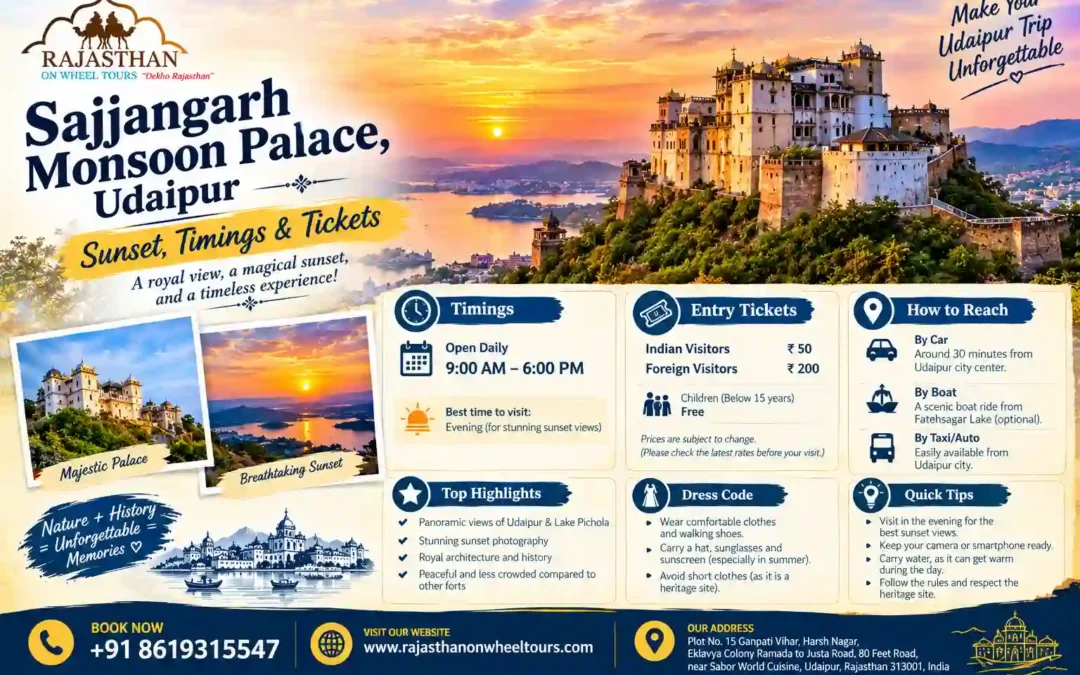
Quick answer: Sajjangarh, the Monsoon Palace, is a white 19th-century palace on a hilltop about 5 km west of Udaipur, built by Maharana Sajjan Singh in the 1880s. It’s known for the sunset view over the city and its lakes. It’s open roughly 9 AM to 6 PM. Entry is about ₹20 for Indians and ₹300 for foreigners, plus a vehicle charge for the drive up through the wildlife sanctuary.
Look west from almost anywhere in Udaipur at dusk and you’ll see it: a pale palace on the highest hill, lit up against the dark. Up close, the palace itself is fairly bare. The view is what you’re paying for, and on a clear evening it’s the best in the city.
Sajjangarh at a Glance
| Item | Details |
|---|---|
| Built | 1884 onwards, Maharana Sajjan Singh |
| Location | Bansdara hill, ~5 km west of the old city |
| Height | Roughly 940 m above sea level |
| Timings | Approx. 9:00 AM – 6:00 PM (sunset closing) |
| Entry (sanctuary + palace) | Approx. ₹20 Indian / ₹300 foreign |
| Private vehicle charge | Approx. ₹300 per car |
| Shared shuttle | Available from the gate (separate fare) |
| Time needed | 1.5 – 2 hours including the drive up |
Fees are set by the forest department and can change. Confirm at the gate.
Why Is It Called the Monsoon Palace?
Maharana Sajjan Singh planned a nine-storey observatory here, high enough to watch the monsoon clouds roll in over the Aravallis. It was also meant to be a retreat in the rainy season, when the views would be at their best. He died young, in 1884, before it was finished, and his successor Maharana Fateh Singh completed a scaled-down version.
The palace later served as a royal hunting lodge, and the hills around it became a protected area.
What You’ll See
The view
From the terraces you can see Lake Pichola, Fateh Sagar, the City Palace and the old city, with the Aravalli ranges rolling away on every side. On clear days after the monsoon you can see a long way. In hazy summer weather, less so.
The palace
White marble and plaster, with arches, balconies and a central courtyard. Some rooms have information panels about the palace’s history and the wildlife of the sanctuary. It’s not a museum in the way the City Palace is. Allow half an hour inside.
Sajjangarh Wildlife Sanctuary
The road up runs through the sanctuary, a protected forest of about 5 sq km. You may spot langurs, peacocks, nilgai or wild boar on the way. Leopards live in the hills but you’re very unlikely to see one.
At the foot of the hill, the separate Sajjangarh Biological Park keeps animals in large enclosures and is popular with families. It has its own ticket and timings.
Sunset at Sajjangarh
This is the main event. The sun sets behind the Aravallis to the west, while the city lights come on below you to the east.
- Arrive 60–75 minutes before sunset. That gives you time for the gate, the drive up and a good spot on the terrace.
- The gates close around sunset. Last vehicles go up before then, and the palace closes soon after the sun goes down, so you won’t be able to linger long after dark.
- Weekends are crowded. The terrace fills, and so does the parking at the top. Weekday evenings are calmer.
If the sky is overcast or hazy, the sunset can be disappointing. October to February usually gives the clearest evenings. Straight after the monsoon, with green hills and clouds, can be spectacular.
What You’re Looking At from the Terrace
Facing east, towards the city, try to pick out:
- Fateh Sagar Lake, to the left (north), with Nehru Garden island in the middle
- Lake Pichola, to the right (south-east), with the white Taj Lake Palace on the water
- The City Palace, a long pale line along Pichola’s eastern shore
- Jag Mandir, a small island at the southern end of Pichola
- Moti Magri, a small green hill on the edge of Fateh Sagar
Facing west, you’re looking over the Aravalli hills, rolling into the distance. This is where the sun goes down.
Sajjangarh Biological Park
At the foot of the hill, near the main gate, Sajjangarh Biological Park houses animals including tigers, leopards, lions, sambar, crocodiles and a variety of birds in large, open enclosures. Paths run around the park, and battery-powered vehicles are usually available for those who don’t want to walk.
It suits families with children who’d find a whole day of palaces too much. Allow about two hours, and visit in the morning or afternoon before heading up the hill for sunset. Entry, timings and the weekly closing day are set separately from the palace, so check before you go.
Photography at Sajjangarh
- Bring a zoom lens if you can. The city and the lakes are a long way down.
- Stay for the blue hour as long as the staff allow. The city lights come on just after sunset.
- Shoot the palace itself from the parking area on the way up, with the sunset behind it.
Getting Up the Hill
From the main gate at the foot of the hill, a road climbs about 4–5 km through the sanctuary. You have two options:
- Drive up in your own car or taxi, paying the vehicle charge at the gate.
- Take the shared shuttle from the gate, which runs on a fixed schedule.
Walking up isn’t normally permitted on the main road.
From the parking area at the top, there’s a short uphill walk to the palace. It’s manageable for most people, but take it slowly with elderly travellers.
Best Time to Visit
- Time of day: late afternoon to sunset.
- Season: October to March for clear skies. August and September for green hills and dramatic clouds (check the road is open in heavy rain).
- Avoid: midday in summer, when it’s hot and hazy.
How to Fit It into Your Day
Sajjangarh works best as the last stop on a sightseeing day in north and west Udaipur:
- Saheliyon ki Bari in the afternoon
- Fateh Sagar Lake and Moti Magri
- Sajjangarh for sunset
Then head back to the old city for dinner. If your evening is already planned around the Pichola sunset boat or the Bagore ki Haveli show, do Sajjangarh on a different day. You can’t do all three at sunset.
Tips
- Bring a light jacket in winter. It’s breezy on top.
- Carry water. There are limited facilities at the top.
- Keep food out of sight. Langurs and monkeys may grab it.
- Check the closing time on the day. It changes with the sunset time through the year.
Our drivers know the gate routine and when to set off for sunset. Sajjangarh is part of our Udaipur sightseeing day tour, and our Udaipur tour packages give it its own evening on longer trips.
Call or WhatsApp +91-8619315547, or book a taxi in Udaipur.
Planning more of Rajasthan? Browse all our guides on the Rajasthan Travel Blog.
Frequently Asked Questions
1. What are the timings of the Monsoon Palace in Udaipur?
Sajjangarh is generally open from about 9 AM until sunset, around 6 PM. Closing time shifts with the sunset through the year, so confirm at the gate.
2. What is the entry fee for Sajjangarh?
Recent fees are about ₹20 for Indian visitors and ₹300 for foreign nationals, plus a vehicle charge of around ₹300 if you drive up. Shuttles from the gate have their own fare.
3. Who built the Monsoon Palace in Udaipur?
Maharana Sajjan Singh began it in 1884 as an observatory and monsoon retreat. He died before it was completed, and Maharana Fateh Singh finished a smaller version.
4. Is Sajjangarh worth visiting?
Yes, mainly for the sunset view over Udaipur’s lakes and the Aravallis. The palace itself is fairly bare, so go for the view rather than the interiors.
5. What is the best time to visit Sajjangarh?
Late afternoon to sunset, ideally from October to March for clear skies. Arrive at the gate 60–75 minutes before sunset.
6. Can I drive my own car up to Sajjangarh?
Yes, private cars and taxis can drive up after paying the vehicle charge at the gate. Shared shuttles are also available from the foot of the hill.
7. How far is Sajjangarh from Udaipur city?
About 5 km west of the old city, roughly a 20–30 minute drive to the top, including the climb through the sanctuary.
8. Is Sajjangarh Wildlife Sanctuary different from Sajjangarh Biological Park?
Yes. The sanctuary is the protected forest on the hill that the road passes through. The biological park is a separate zoo-style park at the foot of the hill with its own ticket.
9. How much time is needed at Sajjangarh?
Allow 1.5 to 2 hours, including the gate, the drive up, time on the terraces and the drive down.
10. Can I see Sajjangarh lit up at night?
You can’t visit after closing, but the palace is lit at night and is clearly visible from the old city and the lakeside ghats.