
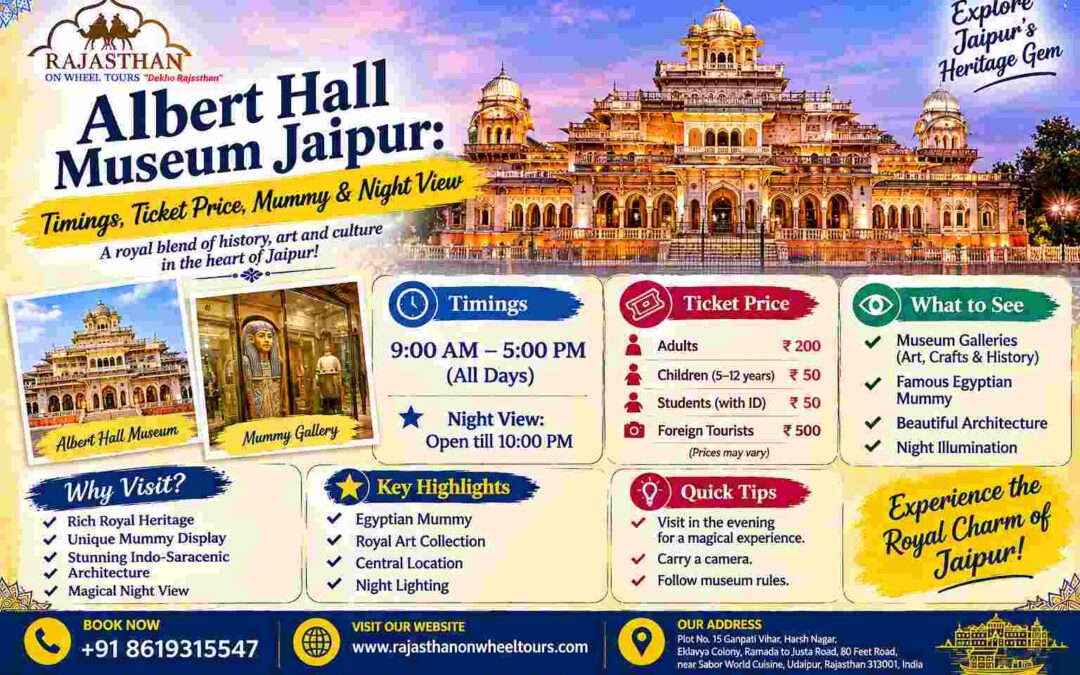
Quick answer: Albert Hall Museum is Rajasthan’s oldest museum, set in Ram Niwas Garden just outside Jaipur‘s New Gate. Designed by Samuel Swinton Jacob and opened in 1887, it holds around 16 galleries, including the Egyptian mummy Tutu. It opens roughly 9 AM to 5 PM, with a night session in the evening. Entry is approx. ₹100 for Indians and ₹600 for foreigners (current rates). Allow 1.5 to 2 hours.
Most people see Albert Hall before they go inside. It sits at the end of the road from New Gate, a domed sandstone building with arched verandas and chhatris, and after dark it glows in shifting colours. Inside is one of the best collections in Rajasthan, and it is far quieter than Amer or Hawa Mahal.
Albert Hall Museum at a Glance
| Item | Details |
|---|---|
| Official name | Government Central Museum (popularly Albert Hall) |
| Location | Ram Niwas Garden, opposite New Gate, Jaipur |
| Foundation stone | 6 February 1876, during the visit of Albert Edward, Prince of Wales |
| Architect | Samuel Swinton Jacob, with Mir Tujumool Hoosein |
| Opened to the public | 1887, under Maharaja Sawai Madho Singh II |
| Style | Indo-Saracenic |
| Galleries | Around 16, with roughly 20,000 objects |
| Star exhibit | Egyptian mummy “Tutu”, Ptolemaic period |
| Day timings | Approx. 9:00 AM – 5:00 PM |
| Night session | Approx. 7:00 PM – 9:30/10:00 PM (check on the day) |
| Time needed | 1.5 – 2 hours inside, plus 20 minutes outside after dark |
Albert Hall Museum Ticket Price
Rajasthan revised entry fees at state-run monuments and museums from 1 January 2026. The rates below are the ones reported for Albert Hall since then. Treat them as approximate and check before you go, because fees here have changed twice in the past 18 months.
| Visitor | General entry (approx.) |
|---|---|
| Indian adult | ₹100 |
| Indian student (with ID) | ₹50 |
| Foreign adult | ₹600 |
| Foreign student (with ID) | ₹300 |
| Children under 7 | Usually free |
- Night entry is a separate ticket. Your day ticket does not cover the evening session.
- Composite tickets cover Albert Hall with Amer Fort, Hawa Mahal, Jantar Mantar, Nahargarh and other state monuments, with validity extended in 2026. If you plan four or more of these, ask at the counter which composite is on sale. City Palace is privately run and not included.
- Free days: the state usually opens its monuments free on dates such as Rajasthan Day (30 March), World Heritage Day (18 April) and World Museum Day (18 May). Expect crowds.
- Where to buy: at the main entrance counter or on the Rajasthan government’s online monument booking portal.
Albert Hall Museum Timings
The museum works in two sessions:
- Day: approx. 9:00 AM to 5:00 PM. The last entry is usually a little before closing.
- Night: approx. 7:00 PM to 9:30 PM, with some listings saying 10:00 PM. You walk through lit galleries and the building is floodlit outside.
Closures are where sources disagree. Some list maintenance closures on certain Mondays or Tuesdays, and Holi is commonly closed, so check the booking portal the evening before. Best time: opening time, before school groups arrive. In summer the galleries make a good midday break from the forts.
The Egyptian Mummy at Albert Hall
Yes, there is a real Egyptian mummy here, and it is the exhibit most Indian visitors ask about first.
- Who she was: a woman called Tutu, from a family of priests, according to the museum.
- Age: from Egypt’s Ptolemaic period (322 BC to 30 BC), so roughly 2,300 years old.
- Where she came from: the Akhmim area of ancient Panopolis in Upper Egypt.
- How she reached Jaipur: she was brought from the Egyptian Museum in Cairo around 1887, the year the museum opened.
In August 2020, heavy rain flooded the basement where Tutu was kept. Staff broke the glass case and carried her to a dry room, and she was later moved to a safer display. She is one of only a handful of Egyptian mummies in India. The room can be busy and dim, so give yourself a few minutes with the panels.
What to See Inside: The Best Galleries
With around 16 galleries, it is easy to wander and miss the highlights. These are the ones worth your time:
- Persian garden carpet: a 17th-century carpet showing a formal garden with water channels, fish and trees, often the quietest room in the building.
- Arms and armour: swords, shields, daggers and armour, many decorated with gold and silver.
- Jewellery and metalwork: enamel, gold and silver pieces from a city still known for jewellery.
- Coin gallery: from the Kushan and Gupta periods to the Mughals and British India.
- Miniature paintings: Rajasthani and Mughal-style work, including the Jaipur school.
- Pottery, sculpture, musical instruments and textiles: good rooms for families.
- The murals: painted scenes from the Mahabharata and Ramayana along the corridors.
Much of the collection was assembled by Thomas Holbein Hendley, a British surgeon, for the Jaipur Exhibition of 1883.
History: Who Built Albert Hall Museum?
Maharaja Sawai Ram Singh II planned the building, and its foundation stone was laid on 6 February 1876 during the Jaipur visit of Albert Edward, Prince of Wales, later King Edward VII. The hall is named after him.
The design came from Samuel Swinton Jacob, who mixed Rajput chhatris and jharokhas with Mughal arches and domes, the style called Indo-Saracenic. Hendley’s collection gave the hall its purpose, and it opened as a public museum in 1887 under Maharaja Sawai Madho Singh II.
Albert Hall at Night
Albert Hall is one of the best night views in Jaipur, and you do not need a ticket for it. From dusk, the façade is lit in changing colours and the plaza fills with families and photographers. Twenty minutes outside is plenty. If you want the galleries too, the night ticket is calmer than the day session. The best photo frame is straight down the main road from New Gate.
Where Is Albert Hall and How to Reach It
Albert Hall stands in Ram Niwas Garden, just south of the walled Pink City, opposite New Gate on Jawaharlal Nehru Marg. Approximate distances by road:
| From | Distance (approx.) |
|---|---|
| Hawa Mahal | 2 – 2.5 km |
| City Palace | 2.5 – 3 km |
| Jaipur Junction railway station | 4 – 5 km |
| Jaipur International Airport | 11 – 12 km |
Autos and app cabs are easy to find. The road outside gets congested in the evening, so if you are touring with a driver, ask to be dropped at the main gate.
Combining Albert Hall with Nearby Sights
Start the morning at Hawa Mahal, then walk to Jantar Mantar and City Palace Jaipur. In the afternoon, step out through New Gate to Albert Hall, then return after dusk for the lit façade. For the full list of sights, see our guide to places to visit in Jaipur.
Tips for Visiting
- Carry ID for the student rate.
- Short on time? One hour covers the mummy, the carpet and the arms gallery. The night session frees daylight for Amer.
- Kids enjoy the mummy, the weapons and the musical instruments most.
- Avoid the free days if you want quiet rooms.
Plan Your Jaipur Trip
Albert Hall is easy to add to a Jaipur sightseeing day with a private car and driver, timed so you reach the façade just after it lights up. See our Jaipur fort sightseeing tour, or the Golden Triangle tour if you are coming from Delhi and Agra.
Call or WhatsApp our Jaipur office on +91-9983889373, or Udaipur on +91-8619315547.
Planning more of Rajasthan? Browse all our guides on the Rajasthan Travel Blog.
Frequently Asked Questions
1. What is Albert Hall Museum in Jaipur?
Albert Hall Museum, officially the Government Central Museum, is the oldest museum in Rajasthan. It holds paintings, carpets, arms, coins, jewellery, pottery, sculpture and an Egyptian mummy in an Indo-Saracenic building inside Ram Niwas Garden. It opened to the public in 1887 and is run by the state’s Archaeology and Museums Department.
2. Who built Albert Hall Museum?
The building was designed by Samuel Swinton Jacob, assisted by Mir Tujumool Hoosein. Maharaja Sawai Ram Singh II planned it, the Prince of Wales laid the foundation stone in 1876, and Maharaja Sawai Madho Singh II opened it as a museum in 1887.
3. What is the Albert Hall Museum entry fee?
Since the January 2026 revision, the reported general entry fee is about ₹100 for Indian adults, ₹50 for Indian students, ₹600 for foreign adults and ₹300 for foreign students. Night entry is a separate ticket. Rates have changed recently, so check at the counter or on the government booking portal.
4. Is the mummy at Albert Hall real?
Yes. The mummy is a real Egyptian woman named Tutu, from a priestly family of Panopolis (Akhmim). She dates to the Ptolemaic period, roughly 2,300 years ago, and was brought from Cairo around 1887. She survived a flood in the museum in 2020 and is now in a dedicated gallery.
5. Is Albert Hall Museum open at night?
Yes. A night session runs in the evening, roughly 7 PM to 9:30 or 10 PM, with a separate ticket. Even without entering, you can stand in the plaza outside and watch the building lit in changing colours from dusk. This is one of the most photographed night views in Jaipur.
6. How much time is needed to visit Albert Hall Museum?
Plan 1.5 to 2 hours to see most galleries at a comfortable pace. If you only want the highlights, the mummy, the Persian carpet and the arms gallery, one hour is enough. Add 20 minutes after dark if you want to see the illuminated façade.
7. Is Albert Hall Museum worth visiting?
Yes, if you enjoy history, craft or architecture. The building is one of Jaipur’s finest, the Persian garden carpet and arms collection are rare, and crowds are smaller than at the forts. With only one day in Jaipur, the night view is an easy way to fit it in.
8. How far is Hawa Mahal from Albert Hall Museum?
Hawa Mahal is roughly 2 to 2.5 km from Albert Hall by road, through New Gate and along the bazaars of the old city. That is about 10 minutes by car or auto-rickshaw outside rush hours, so the two pair well in the same morning or afternoon.
9. Which is the nearest metro station to Albert Hall Museum?
Jaipur Metro’s line through the old city has stations at Chandpole, Choti Chaupar and Badi Chaupar, all inside the walled city rather than at the museum. From any of them, it is a short auto ride to New Gate and Ram Niwas Garden. Most visitors find a cab or auto simpler.
10. Is photography allowed inside Albert Hall Museum?
Photography is generally allowed inside without flash, and the exterior can be photographed at any time. Some galleries may carry their own restrictions and tripods may need permission, so follow the signs and staff instructions, especially in the mummy gallery.