
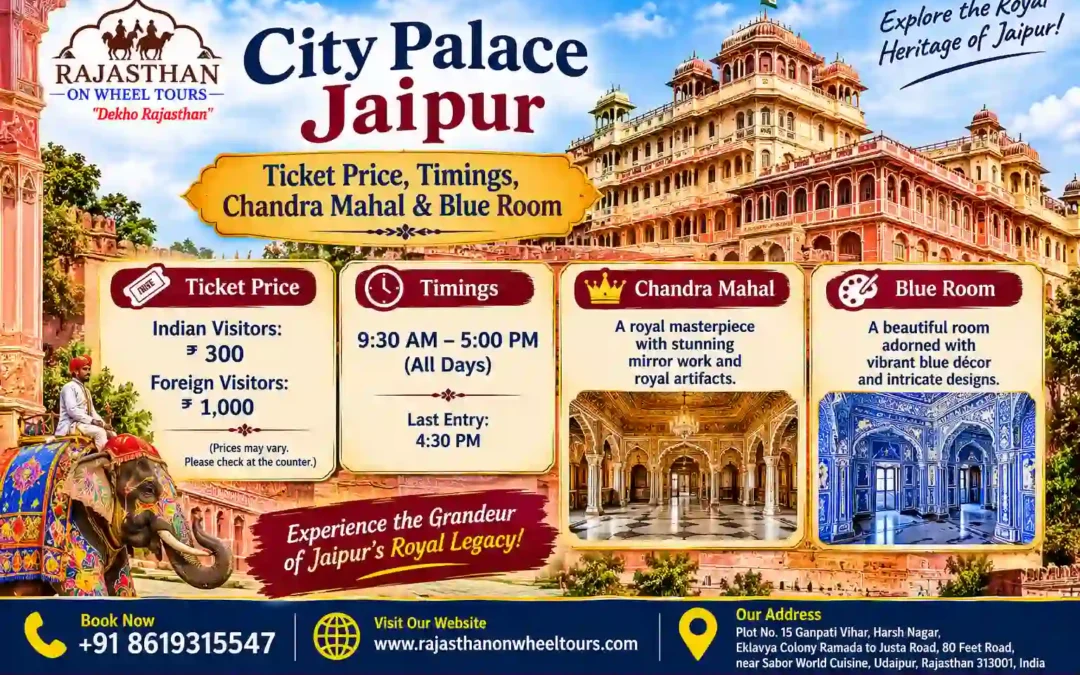
Quick answer: City Palace Jaipur is the royal palace at the heart of the Pink City, built from about 1729 by Maharaja Sawai Jai Singh II and still home to the former royal family. It opens daily, approx. 9:30 AM to 6:30 PM. A standard museum ticket is approx. ₹400 per adult; the Chandra Mahal Royal Tour, which includes the Blue Room, costs approx. ₹4,000. Allow 2 to 3 hours.
City Palace is not a ruin or a state monument. It is a working royal residence with a museum around it, and the seven-storey Chandra Mahal at its centre is still the family’s home.
City Palace Jaipur at a Glance
| Item | Details |
|---|---|
| Built by | Maharaja Sawai Jai Singh II, from about 1729 |
| City planner | Vidyadhar Bhattacharya |
| Location | Inside the walled Pink City, next to Jantar Mantar |
| Run by | Maharaja Sawai Man Singh II Museum Trust (private, not the state) |
| Owners | The former royal family of Jaipur, who still live in Chandra Mahal |
| Timings | Approx. 9:30 AM – 6:30 PM daily, last tickets around 6:00 PM |
| Closed | Dhulandi (the day after Holika Dahan) |
| Museum ticket | Approx. ₹400 adult, ₹200 student/child |
| Royal Tour (Chandra Mahal) | Approx. ₹4,000 adult |
| Time needed | 2 – 3 hours; add about an hour for the Royal Tour |
| Nearest metro | Badi Chaupar (Pink Line) |
City Palace Jaipur Ticket Price
City Palace is run by a private trust, so the state composite ticket for Amer, Hawa Mahal and Albert Hall does not cover it. The palace’s own website lists these rates; treat them as approximate and check before you go.
| Ticket | Adult | Student / child under 12 | Senior citizen / defence | What it covers |
|---|---|---|---|---|
| City Palace Museum | ₹400 | ₹200 | ₹200 | Courtyards and galleries |
| Composite | ₹500 | ₹300 | ₹300 | Museum plus Jaigarh Fort and the Royal Cenotaphs (Gaitore) |
| Museum at Night | ₹510 | ₹260 | ₹210 | Evening entry with light and sound (temporarily closed) |
| Chandra Mahal Royal Tour | ₹4,000 | ₹2,000 | — | Museum plus private floors of Chandra Mahal, personal guide, refreshments |
- Foreign visitors: older guides quote a higher foreigner rate. The current official list shows single adult prices, so confirm at the counter.
- Children under 5 go free; carry ID for the student rate.
- Royal Tour tickets are sold only at the counter. Guides cost extra.
- Golf carts cost about ₹150 per person, useful for older travellers.
- Book online only on the palace’s official website, not look-alike sites.
City Palace Jaipur Timings
- Museum and Royal Tour: approx. 9:30 AM to 6:30 PM, every day; ticket sales close around 6:00 PM. Closed on Dhulandi.
- Museum at Night: listed for 7:00 PM, but marked temporarily closed. Check before planning an evening visit.
Older articles still give a 5:00 PM closing; the palace’s own site now shows 6:30 PM. Best time: opening time for quiet courtyards, or after 4 PM when groups have moved on. October to March is the most comfortable season.
What to See Inside City Palace Jaipur
Mubarak Mahal
The first building you reach after the entry gates, Mubarak Mahal was built around 1900 to receive guests. Its carved white marble and sandstone mix Rajput, Mughal and European details. It has housed the textile and costume gallery, but that gallery has been closed for restoration since March 2026, so ask what is open.
Sileh Khana (Armoury)
A fine arms collection of swords, daggers, shields, guns and armour, many with jewelled hilts and engraved blades.
Diwan-i-Khas (Sarvato Bhadra) and the Silver Urns
This open hall of private audience holds the two Gangajalis, huge sterling silver urns each about 1.6 m tall. Maharaja Sawai Madho Singh II had them made to carry Ganga water on his 1902 voyage to England for the coronation of Edward VII. They are listed as the largest sterling silver vessels in the world.
Diwan-i-Aam (Sabha Niwas)
The hall of public audience, with painted ceilings, chandeliers and portraits of the Jaipur rulers.
Pritam Niwas Chowk and the Four Gates
This inner courtyard is the most photographed spot in the palace. Each of its four doorways represents a season and a deity:
| Gate | Season | Deity |
|---|---|---|
| Peacock Gate | Autumn | Vishnu |
| Lotus Gate | Summer | Shiva and Parvati |
| Green (Leheriya) Gate | Spring | Ganesha |
| Rose Gate | Winter | Devi |
The Peacock Gate is the favourite for photos. Go early if you want it without a crowd.
Chandra Mahal
The seven-storey Chandra Mahal is the oldest part of the palace. The royal standard flies from the Mukut Mandir on top, with a smaller extra flag when the head of the family is at home. Going inside needs the Royal Tour.
The Chandra Mahal Royal Tour and the Blue Room
The Royal Tour takes small groups with a personal guide into private floors of Chandra Mahal. According to the palace, it covers Sri Niwas, Chhavi Niwas, Shobha Niwas and Pritam Niwas, with refreshments.
- Chhavi Niwas, the Blue Room: walls and ceiling painted in blue with white patterns, one of the most photographed interiors in India.
- Shobha Niwas: walls covered in mirror work, coloured glass and gold leaf.
- Upper floors: views across the Pink City towards Nahargarh.
Is it worth ₹4,000? If you care about interiors, photography or royal history, yes. These rooms are still lived-in and you will not see them any other way. If you are on a budget or visiting with young children, the standard ticket already covers the courtyards, the silver urns, the armoury and the four gates.
History: Who Built City Palace Jaipur?
Maharaja Sawai Jai Singh II moved his capital from Amer to the plains in 1727 and founded Jaipur, one of India’s earliest planned cities. Vidyadhar Bhattacharya, a Bengali scholar in his service, guided the city’s grid plan. Work on the palace began around 1729, at the centre of the new city.
Later rulers kept adding to it, and Mubarak Mahal dates from around 1900. After Independence the palace stayed with the family, and the museum opened in 1959 in the name of Maharaja Sawai Man Singh II.
Who Lives in City Palace Jaipur Today?
The palace remains the home and ceremonial seat of the former royal family of Jaipur, now headed by Sawai Padmanabh Singh. The family lives in parts of Chandra Mahal, and the rest is run as a museum by the family trust.
City Palace Jaipur vs City Palace Udaipur
| Jaipur | Udaipur | |
|---|---|---|
| Setting | Flat, inside a planned walled city | On the shore of Lake Pichola |
| Built | From about 1729 | From the 16th century onwards |
| Highlights | Pritam Niwas gates, silver urns, Blue Room | Lake views, mirror and glass halls, courtyards |
| Visit time | 2 – 3 hours | 2 – 3 hours |
Udaipur wins on setting; Jaipur wins on the painted gates and the lived-in residence. Also see our City Palace Udaipur guide.
How to Reach and Nearby Sights
City Palace sits in the middle of the walled city. There are two ticket gates: Gate 1, near the Jantar Mantar ticket counter, and Gate 2, at Jaleb Chowk, where the parking is. The nearest metro station is Badi Chaupar.
Jantar Mantar is next door and Hawa Mahal a short walk away; Albert Hall Museum is just outside the walls. Most travellers see Amer Fort in the morning and the old city after lunch. For more, see places to visit in Jaipur.
Tips for Visiting City Palace Jaipur
- Photography: allowed in courtyards; some galleries restrict cameras.
- Families with kids: the armoury and silver urns hold attention best.
- Accessibility: wheelchairs, ramps and accessible restrooms are available at major entrances.
- Late morning is the busiest time.
Plan Your Jaipur Trip
City Palace sits at the centre of most Jaipur sightseeing days, and a private car makes it easy to link with Amer, Hawa Mahal and Albert Hall. Our drivers can drop you at Gate 2 and collect you when you are done. See our Jaipur fort sightseeing tour for a full day.
Call or WhatsApp our Jaipur office on +91-9983889373, or Udaipur on +91-8619315547.
Planning more of Rajasthan? Browse all our guides on the Rajasthan Travel Blog.
Frequently Asked Questions
1. Why is City Palace Jaipur famous?
City Palace is famous as the seat of the Jaipur royal family since the 1720s and as one of the few royal palaces in India still lived in. Visitors come for the four painted gates of Pritam Niwas Chowk, the giant silver Gangajalis, the armoury and the Blue Room inside Chandra Mahal.
2. What is the City Palace Jaipur ticket price for students?
The official rate for students and children under 12 is approx. ₹200 for the museum, ₹300 for the composite ticket and ₹2,000 for the Royal Tour. Carry a valid student ID. Children under five enter free. Rates can change, so check the palace website before you visit.
3. Can we visit City Palace Jaipur at night?
The palace has offered a Museum at Night session around 7 PM with a light and sound show, but it is listed as temporarily closed. Daytime visits run until about 6:30 PM. If the evening session reopens, it needs its own ticket, so check the official website before planning.
4. Who owns City Palace Jaipur?
The palace belongs to the former royal family of Jaipur. The museum section is run by the Maharaja Sawai Man Singh II Museum Trust, a private trust, which is why it uses its own tickets rather than the Rajasthan government’s monument tickets.
5. Can we stay in City Palace Jaipur?
No, City Palace is not a hotel. The family lives in Chandra Mahal and the rest is a museum. For a royal-style stay, Jaipur has heritage hotels in former palaces and havelis, and staying near the old city keeps your sightseeing drives short.
6. Is the Royal Tour worth it?
It is worth it if you want to see the Blue Room, Shobha Niwas and the lived-in upper floors of Chandra Mahal with a personal guide. At about ₹4,000 per adult it is expensive, so budget travellers and families with small children usually find the standard museum ticket enough.
7. Is City Palace Jaipur included in the composite ticket?
Not in the government composite ticket that covers Amer Fort, Hawa Mahal, Jantar Mantar, Nahargarh and Albert Hall. City Palace has its own composite of approx. ₹500, covering the museum, Jaigarh Fort and the Royal Cenotaphs at Gaitore.
8. Where is City Palace located in Jaipur?
City Palace is in the centre of the walled Pink City, next to Jantar Mantar and a short walk from Hawa Mahal. Visitors enter through Gate 1 near the Jantar Mantar ticket counter or Gate 2 at Jaleb Chowk, which has parking. Badi Chaupar is the nearest metro station.
9. How much time is needed for City Palace Jaipur?
Most visitors need 2 to 3 hours to see the courtyards, galleries, silver urns and Pritam Niwas Chowk at a relaxed pace. Add roughly an hour if you take the Chandra Mahal Royal Tour. Combine it with Jantar Mantar next door for a half day.
10. City Palace Jaipur or Amer Fort: which should I see first?
See Amer Fort first, in the morning, when it is cooler and the hilltop is less crowded. Come down to City Palace after lunch, then walk to Jantar Mantar and Hawa Mahal. This order follows the history too, from the old Amer capital to the new city.