
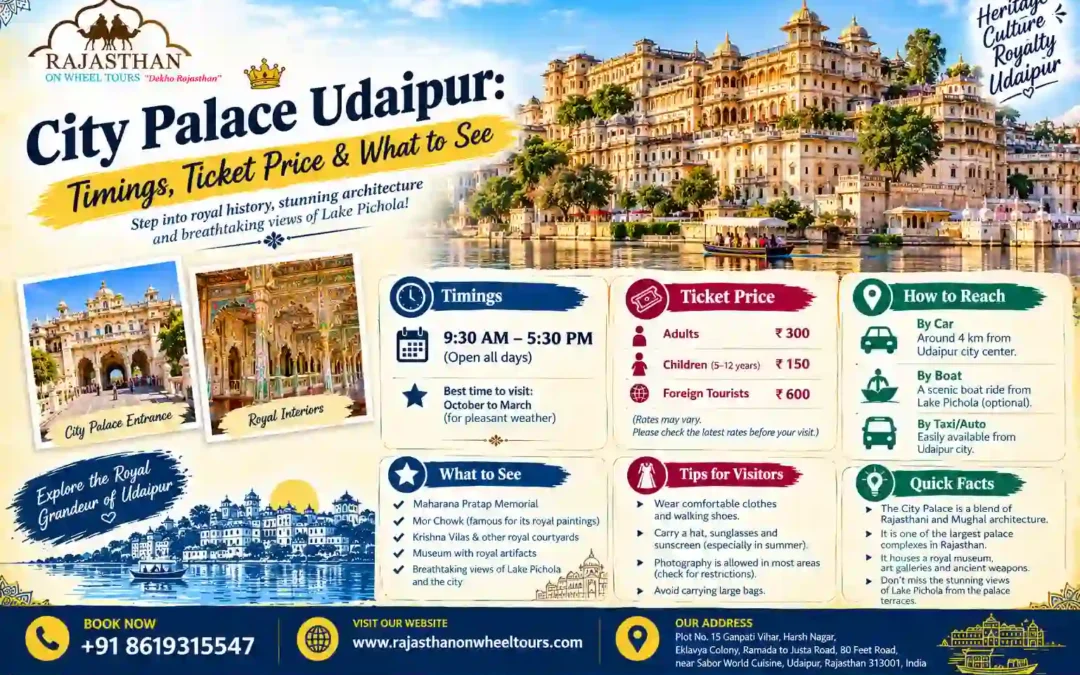
Quick answer: City Palace Udaipur is a complex of interconnected palaces built over about 400 years by the Mewar rulers, starting with Maharana Udai Singh II in 1559. The museum is open daily from about 9:30 AM to 5:30 PM. Recent museum tickets are around ₹300 for Indian adults, ₹100 for children and ₹600 for foreigners, with extra charges for cameras and the Crystal Gallery. Allow 2.5–3 hours and arrive at opening.
The City Palace is the biggest palace complex in Rajasthan, and it’s built like a maze on purpose. Narrow staircases, sharp turns and low doorways were designed to slow down attackers. Today they slow down tour groups, which is exactly why timing matters. Walk in at 9:30 AM and you’ll have the courtyards almost to yourself. Walk in at 11 and you’ll queue on every staircase.
City Palace Udaipur at a Glance
| Item | Details |
|---|---|
| Built | From 1559, extended over ~400 years |
| Museum timings | Approx. 9:30 AM – 5:30 PM, daily |
| Museum ticket (Indian adult) | Approx. ₹300 |
| Museum ticket (child 5–18) | Approx. ₹100 |
| Museum ticket (foreign national) | Approx. ₹600 |
| Camera | Mobile phones usually free; DSLR/video extra |
| Crystal Gallery | Separate ticket (approx. ₹550 Indian / ₹700 foreign) |
| Time needed | 2.5 – 3 hours |
| Evening | Sound and light show at Manek Chowk |
Prices are from 2025–26 published rates and are revised periodically. Check at the ticket counter.
A Little History
Maharana Udai Singh II founded Udaipur in 1559, after Mughal pressure made Chittorgarh too exposed. He began the palace on a ridge above Lake Pichola. Over the next four centuries, his successors kept adding to it: new wings, courtyards, towers and balconies. That’s why the complex feels like many palaces joined together. It is.
Part of the complex is still used by the Mewar royal family today. The rest is the City Palace Museum, run by a family trust, and two sections are luxury hotels.
What to See Inside the City Palace
You’ll follow a set route through the museum. These are the rooms worth slowing down for.
Tripolia and Badi Pol
The approach takes you through Badi Pol, the “Great Gate”, and then Tripolia, a triple-arched gate built in the early 18th century. Rulers were once weighed against gold and silver here, with the treasure given away to charity.
Manak Mahal and Suraj Gokhda
Manak Mahal is decorated with mirror work and glass inlay. Nearby, the Suraj Gokhda balcony shows the sun emblem of the Mewar dynasty, which traced its line back to the sun god. The rulers showed themselves to the public from here in difficult times.
Mor Chowk (Peacock Courtyard)
The highlight for most visitors. Three peacocks, made from thousands of pieces of coloured glass mosaic, decorate the walls of this small courtyard, each representing a season. The colours shift as you move. It’s the most photographed spot in the palace, so you’ll want to be early.
Sheesh Mahal and Bhim Vilas
Sheesh Mahal, the “Palace of Mirrors”, has walls inlaid with mirrors. Bhim Vilas has miniature paintings of Radha and Krishna, and a gallery of glass and mirror work.
Zenana Mahal
The former queens’ quarters, now a gallery of paintings, royal palanquins and portraits. The large courtyard outside, Laxmi Chowk, is one of the most peaceful spaces in the complex.
Amar Vilas
A hanging garden at the top of the palace, with a marble pool, arches and views across Lake Pichola. It’s the highest point of the complex and a good place to pause.
Crystal Gallery (separate ticket)
In the Fateh Prakash Palace, the Crystal Gallery displays crystal furniture, chandeliers and tableware ordered from England by Maharana Sajjan Singh in 1877. He died before it arrived, and the boxes stayed unopened for over a century. It’s unusual and lavish. Photography isn’t allowed, and the ticket is expensive, so it suits people with a specific interest.
A Simple Route Through the Palace
If you don’t have a guide, this order works well:
- Enter through Badi Pol and Tripolia, and buy any add-on tickets (camera, Crystal Gallery, boat).
- Walk up into the museum through Ganesh Deodhi, where a small shrine to Ganesh greets visitors.
- Climb to Amar Vilas, the hanging garden, for the first big lake view.
- Continue through Badi Mahal, Sheesh Mahal and Bhim Vilas.
- Spend time in Mor Chowk before the crowds catch up with you.
- Walk through Manak Mahal and the Zenana Mahal galleries.
- Finish in Laxmi Chowk, then head down to the Crystal Gallery or Rameshwar Ghat if you have tickets.
The museum route is one-way in places, so it’s hard to double back. Take your photos as you go.
How Long Does It Take?
| Visit style | Time |
|---|---|
| Quick walk through the museum | 1.5 hours |
| Museum at a comfortable pace | 2.5 – 3 hours |
| Museum, Crystal Gallery and boat ride | Half a day |
Getting the Most from Your Visit
- Arrive at opening. The difference in crowds between 9:30 and 11 AM is enormous.
- Take an audio guide or hire a guide. Without context, the rooms blur together. With a guide, the paintings and stories make sense. See our local guides in Udaipur.
- Wear comfortable shoes. There are many steep, narrow staircases.
- Buy your boat ticket on the way in. If you want the Lake Pichola sunset boat from Rameshwar Ghat, which is inside the complex, buy it in the morning before it sells out.
- Carry water. Some sections get warm, especially from March onwards.
- Note the parking. Cars can’t reach the main gate through the old city lanes. Your driver will drop you near the palace entrance or nearby parking, with a short uphill walk.
Visiting with Children
Children usually enjoy the peacocks of Mor Chowk, the armour and weapons, and the views from the top. The narrow staircases are the challenge: hold small hands on the steep sections, and leave large prams at the entrance. A visit of about two hours, followed by the boat ride, keeps most children happy.
What to Wear
There’s no strict dress code, but modest, comfortable clothes are sensible, since parts of the palace are still used for family and religious functions. Wear shoes with grip. The marble floors and stone steps can be slippery, and you’ll be on your feet for hours. In winter, mornings are cool, so bring a light layer you can take off later.
Is City Palace Udaipur Accessible?
Partly. The courtyards at ground level are manageable, but much of the museum route involves narrow, steep stairs. Travellers with limited mobility may see the lower courtyards, Laxmi Chowk and the views, and skip the upper galleries.
Evening at the City Palace
The sound and light show at Manek Chowk tells the story of Mewar in the evening, with English and Hindi sessions depending on the season. After dark, the best view of the palace is actually from outside: across the water from Ambrai Ghat, when the whole facade is lit up.
Combining the City Palace with the Rest of Udaipur
The palace sits at the heart of the old city, so it’s easy to combine with:
- Jagdish Temple, a two-minute walk away, built in 1651
- Lake Pichola boat ride from Rameshwar Ghat, inside the complex
- Bagore ki Haveli, a short walk down to Gangaur Ghat, for the evening folk dance show
Our Udaipur sightseeing day tour puts the palace first thing in the morning and builds the rest of the day around it. For longer stays, see our Udaipur tour packages.
Call or WhatsApp +91-8619315547, or book a taxi in Udaipur.
Planning more of Rajasthan? Browse all our guides on the Rajasthan Travel Blog.
Frequently Asked Questions
1. What are the City Palace Udaipur timings?
The City Palace Museum is generally open every day from about 9:30 AM to 5:30 PM. Arrive at opening to avoid the crowds that build from late morning.
2. What is the City Palace Udaipur ticket price?
Recent museum prices are around ₹300 for Indian adults, ₹100 for children aged 5–18 and ₹600 for foreign nationals. Cameras, the Crystal Gallery and boat rides are charged separately. Confirm current prices at the counter.
3. How much time is needed to see City Palace Udaipur?
Allow 2.5 to 3 hours to see the museum comfortably. Add time if you’re visiting the Crystal Gallery or taking the Lake Pichola boat ride from the palace jetty.
4. Who built the City Palace in Udaipur?
Maharana Udai Singh II began the palace in 1559 when he founded Udaipur. His successors extended it over about four centuries, which is why it’s a complex of many connected palaces.
5. What is the best thing to see inside the City Palace?
Mor Chowk, the courtyard with three glass-mosaic peacocks, is the most famous sight. Sheesh Mahal, Zenana Mahal and the Amar Vilas hanging garden are also highlights.
6. Is the Crystal Gallery worth it?
It’s worth it if you’re interested in decorative arts. It displays 19th-century crystal furniture and chandeliers ordered from England by Maharana Sajjan Singh. The ticket is expensive and photography isn’t allowed.
7. Is photography allowed in City Palace Udaipur?
Photography is allowed in most of the museum. Mobile phones are usually free, while DSLR and video cameras need a separate ticket. Photography isn’t permitted in the Crystal Gallery.
8. Can I take the Lake Pichola boat ride from the City Palace?
Yes. The main boat ride leaves from Rameshwar Ghat inside the City Palace complex and stops at Jag Mandir island. Buy sunset tickets early in peak season.
9. Is there a light and sound show at City Palace Udaipur?
Yes. An evening sound and light show at Manek Chowk tells the story of Mewar. Timings and languages change with the season, so check at the palace.
10. Do the royal family still live in the City Palace?
Yes. Part of the complex is still used by the Mewar royal family. The rest is the City Palace Museum and two heritage hotels.