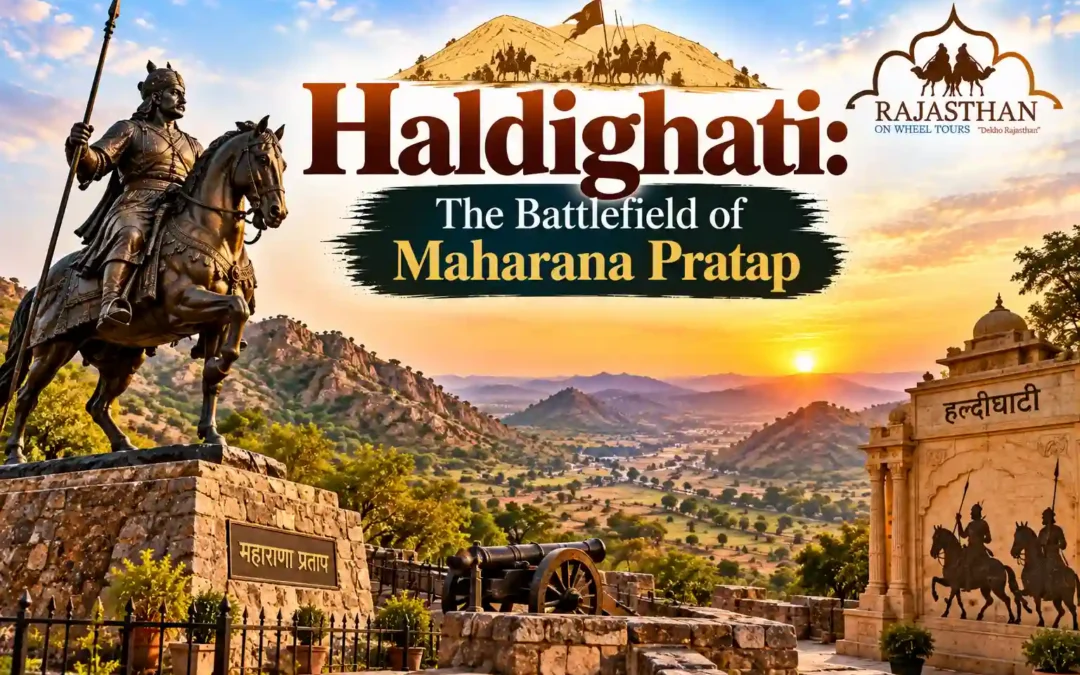
Quick answer: Haldighati is a narrow mountain pass in the Aravallis, about 40 km north of Udaipur, where Maharana Pratap of Mewar fought the Mughal army of Emperor Akbar, led by Raja Man Singh of Amber, on 18 June 1576. The pass takes its name from its turmeric-yellow soil (haldi). Today visitors come for the Maharana Pratap museum, Chetak’s memorial, the Rakt Talai battlefield, and the rose products of the surrounding villages. Allow 2–3 hours, and combine it with Nathdwara nearby.
Haldighati isn’t a grand monument. It’s a quiet pass, a small museum, a memorial to a horse and a tank of water. What makes it matter is the story. For many Indians, and for everyone in Mewar, the Battle of Haldighati is the defining story of Rajput resistance. Visiting the site after hearing it properly is one of the most moving half-days in Rajasthan.
The Battle of Haldighati: What Happened
The background
By the 1570s, Emperor Akbar had brought most of Rajasthan’s Rajput kingdoms into the Mughal empire, many through alliance and marriage. Mewar refused. Akbar had taken Chittorgarh in 1568, and the Mewar court had moved to Udaipur and the hills.
When Maharana Pratap took the throne in 1572, Akbar sent several envoys to persuade him to accept Mughal authority. Pratap refused them all.
The armies
In 1576, Akbar sent a large army under Raja Man Singh I of Amber (Jaipur), a Rajput general in Mughal service. It’s one of the great ironies of Haldighati: a Rajput led the Mughal army against a Rajput king.
Maharana Pratap’s force was smaller. It included Rajput cavalry, a contingent under the Afghan commander Hakim Khan Sur, and Bhil archers under Rana Punja, whose knowledge of the hills was vital. Estimates of the numbers vary widely between historians.
The battle
The armies met on 18 June 1576 near the Haldighati pass and the village of Khamnor. The fighting lasted only a few hours, but it was brutal. Pratap’s cavalry charged the Mughal lines, and at one point Pratap reached Man Singh himself, whose elephant was attacked by Pratap’s horse, Chetak.
As the battle turned, Pratap was wounded. His companions persuaded him to withdraw so the fight could continue another day. A loyal chieftain, Jhala Man Singh (Jhala Bida), took up the royal insignia so the Mughals would target him instead. He died on the field.
Who won?
Militarily, the Mughals held the field. But they failed in their goal: Pratap escaped, was never captured, and never submitted. Over the following years he fought a long guerrilla campaign from the hills, and by his death in 1597 he had won back much of Mewar, though not Chittorgarh.
That’s why Haldighati is remembered in Rajasthan less as a defeat than as a symbol of defiance.
The Story of Chetak
No account of Haldighati is complete without Chetak, Maharana Pratap’s horse.
According to tradition, Chetak was badly wounded in the leg during the charge on Man Singh’s elephant. He still carried Pratap out of the battle, and leapt a stream to get his rider to safety before collapsing and dying. Pratap is said to have built a memorial where Chetak fell.
Whether every detail is historical or legend, Chetak has become one of the most famous horses in Indian history, the subject of poems, songs and school textbooks.
Maharana Pratap: A Short Timeline
Haldighati is one day in a remarkable life. This timeline puts it in context.
| Year | Event |
|---|---|
| 1540 | Born at Kumbhalgarh Fort to Maharana Udai Singh II |
| 1568 | Akbar captures Chittorgarh; Mewar’s court moves to Udaipur and the hills |
| 1572 | Becomes Maharana of Mewar at Gogunda |
| 1572–1576 | Rejects several Mughal envoys urging him to submit |
| 18 June 1576 | Battle of Haldighati |
| 1576–1580s | Guerrilla campaign from the Aravallis, supported by the Bhils |
| 1582 | Victory at the Battle of Dewair, a turning point in reclaiming Mewar |
| 1585 onwards | Rules from Chavand, his new capital |
| 1597 | Dies at Chavand, having recovered much of Mewar except Chittorgarh |
After the battle, the Mughals held Gogunda and parts of Mewar, but they could never hold the hills. Pratap’s refusal to submit, even when he and his family faced hardship in the forests, is the heart of his legend.
What to See at Haldighati
Maharana Pratap Museum (Haldighati Museum)
The main attraction. The museum tells the story of Pratap and the battle through dioramas, life-size figures, weapons, paintings and a short film show. It’s aimed at a general audience and works especially well for families and children.
The museum complex also has a small garden and a shop selling local rose products. The museum is typically open during the day and charges a small entry fee.
Chetak Smarak
A small memorial marks the spot where Chetak is said to have fallen, near the village of Balicha. It’s simple, a platform and a cenotaph, but many visitors find it the most emotional stop of the day.
Rakt Talai
At Khamnor, a few kilometres from the pass, lies Rakt Talai, meaning “pond of blood”. This is where the fiercest fighting took place. Today it’s a quiet walled garden with memorials to the fallen, including Hakim Khan Sur. It’s often skipped, but it’s the actual battlefield.
The Haldighati pass and yellow soil
Drive or walk a stretch of the narrow pass and you’ll see the yellow earth that gives it its name. It’s a striking colour, especially after rain.
Rose fields and gulkand
The villages around Haldighati are known for growing fragrant chaitri roses, which bloom around March–April. Local families turn them into gulkand (rose petal preserve), rose water and rose sherbet. You’ll find them sold at the museum and roadside shops, and they make good gifts.
How Much Time Do You Need?
| Stop | Time |
|---|---|
| Maharana Pratap Museum | 1 – 1.5 hours |
| Chetak Smarak | 20 minutes |
| Rakt Talai | 20 – 30 minutes |
| Haldighati pass drive | 15 minutes |
| Total | 2 – 3 hours |
Combine Haldighati with Nathdwara
Haldighati sits close to Nathdwara, home of the Shrinathji temple, one of the most important Krishna temples in India. The two combine naturally into a half-day or full-day trip from Udaipur.
A simple plan:
- 8:00 AM – Leave Udaipur.
- 9:15 AM – Nathdwara: Shrinathji darshan (timed around the temple’s darshan windows) and the Statue of Belief.
- 11:30 AM – Drive to Haldighati.
- 12:00 PM – Museum, Chetak Smarak and Rakt Talai.
- 2:30 PM – Lunch.
- 3:30 PM – Return to Udaipur.
With an extra hour or two, you can continue north towards Kumbhalgarh, where Maharana Pratap was born. See our Kumbhalgarh Fort guide.
Why Haldighati Still Matters
Nearly 450 years later, Haldighati remains a living story in Mewar. Maharana Pratap’s statue stands at Moti Magri in Udaipur, schoolchildren across India learn the Chetak story, and poems like Shyam Narayan Pandey’s Haldighati are still recited.
The battle also carries a quieter lesson. The Bhil archers who fought alongside Pratap, and who sheltered him in the hills afterwards, are remembered in Mewar’s royal emblem, which shows a Rajput and a Bhil side by side. Haldighati is a story of a king, but also of the communities that stood with him.
Standing in the pass, you understand why the hills mattered. The narrow valley and the surrounding ridges gave a smaller army its best chance, and the same hills later made the long guerrilla campaign possible.
Best Time to Visit Haldighati
- October to March: Pleasant weather for walking between sites.
- March to April: The rose season, when the fields bloom and fresh gulkand is made.
- June: The battle anniversary on 18 June is marked locally, but it’s very hot.
- Monsoon (July–September): The hills turn green and the yellow soil of the pass is at its most vivid. Paths can be muddy.
Every year on Maharana Pratap Jayanti, his birth anniversary (celebrated around May–June on the Hindu calendar), events are held across Mewar, including at Haldighati.
Visiting Haldighati with Children
Haldighati is one of the best history outings in Rajasthan for children, because the story is simple and heroic: a brave king, a loyal horse, a battle in the hills. A few ideas:
- Tell them the Chetak story in the car before you arrive. It makes the memorial meaningful.
- Let the museum dioramas do the work. The life-size figures and film are designed for general audiences.
- Keep it to half a day. Two to three hours is plenty for younger children.
- Pair it with something light, like a lunch stop and rose sherbet, or Nathdwara’s busy temple lanes.
Where to Eat
Simple dhabas and small restaurants near the museum and along the Nathdwara road serve Rajasthani thalis, dal-baati and snacks. Nathdwara itself has many vegetarian restaurants and sweet shops. It’s a good lunch stop if you combine the two. Try a glass of rose sherbet in Haldighati; it’s a local specialty.
Who Should Visit?
- Families with children: The museum’s dioramas and film make the history easy to follow.
- History lovers: Especially paired with Chittorgarh and Kumbhalgarh, the three places that tell the story of Mewar.
- Travellers staying in Udaipur for 3+ days: It’s an easy and meaningful half-day outing.
If you only have one day in Udaipur, stay in the city. Haldighati rewards those with time.
Tips for Your Visit
- Hear the story before you go. Read this guide or watch a short documentary on the drive. The sites are simple; the story brings them to life.
- Don’t skip Rakt Talai. It’s the actual battlefield.
- Carry cash for museum tickets and rose products.
- Wear comfortable shoes. There’s a little walking between sites.
- Buy gulkand from local makers, not only the museum shop.
Plan Your Haldighati Trip
We run half-day and full-day Haldighati and Nathdwara trips from Udaipur, with drivers who know the story as well as the road. See our Udaipur to Haldighati taxi service or call us to plan a Mewar history day.
Call or WhatsApp +91-8619315547.
Planning more of Rajasthan? Browse all our guides on the Rajasthan Travel Blog.
Frequently Asked Questions
1. What is Haldighati famous for?
Haldighati is famous as the site of the Battle of Haldighati on 18 June 1576, fought between Maharana Pratap of Mewar and the Mughal army led by Raja Man Singh. It’s also known for its yellow soil and its rose products.
2. Who won the Battle of Haldighati?
The Mughal army held the field at the end of the day, but it failed to capture or subdue Maharana Pratap. He escaped, continued fighting, and later recovered much of Mewar, so the battle is remembered as a symbol of resistance.
3. Why is it called Haldighati?
The name comes from the turmeric-yellow colour of the soil in the pass. Haldi means turmeric, and ghati means valley or pass.
4. Who led the Mughal army at Haldighati?
The Mughal army was led by Raja Man Singh I of Amber, a Rajput general serving Emperor Akbar. Maharana Pratap’s forces included Rajput cavalry, Afghan soldiers under Hakim Khan Sur and Bhil archers under Rana Punja.
5. What happened to Chetak?
According to tradition, Chetak, Maharana Pratap’s horse, was badly wounded during the battle but carried Pratap to safety, leaping a stream before collapsing and dying. A memorial, Chetak Smarak, marks the spot.
6. What is Rakt Talai?
Rakt Talai, meaning “pond of blood”, is the site near Khamnor where the fiercest fighting took place. Today it’s a peaceful walled garden with memorials to those who died in the battle.
7. How far is Haldighati from Udaipur?
Haldighati is about 40 km north of Udaipur, roughly an hour’s drive. It’s close to Nathdwara, so the two are often visited together on a half-day or full-day trip.
8. How much time do I need at Haldighati?
Plan 2 to 3 hours to see the museum, Chetak Smarak, Rakt Talai and the pass. Add 2 hours if you combine it with Nathdwara’s Shrinathji temple.
9. What is gulkand, and why is Haldighati known for it?
Gulkand is a sweet preserve made from rose petals. The villages around Haldighati grow fragrant chaitri roses, which bloom in spring, and local families make gulkand, rose water and sherbet from them.
10. Is Haldighati worth visiting?
Yes, especially if you’re interested in Rajput history or travelling with children. The sites are modest, but the story is powerful, and it pairs well with Nathdwara and Kumbhalgarh.