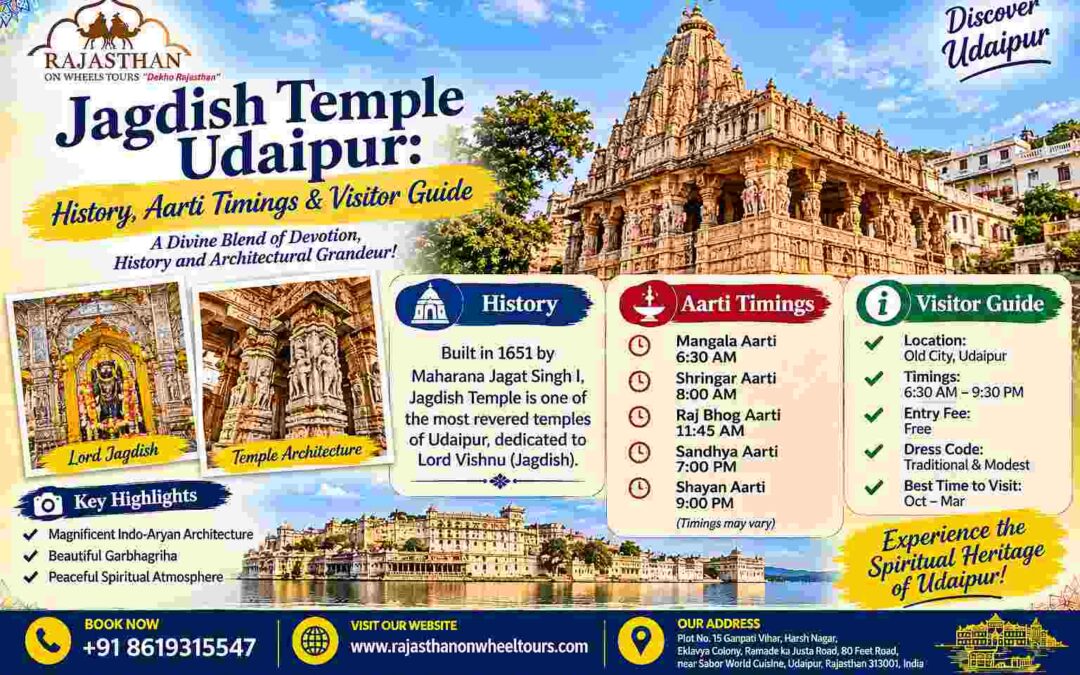
Quick answer: Jagdish Temple is a 17th-century Vishnu temple in Udaipur’s old city, built by Maharana Jagat Singh I and completed in 1651. It stands on a high platform reached by 32 marble steps, about 150 metres from the City Palace’s Bara Pol. Entry is free. Darshan runs roughly from early morning to around 1–2 PM and again from late afternoon to about 8 PM. Allow 30–60 minutes.
Every lane from the palace, the ghats and the bazaar seems to lead to Jagdish Temple’s steps. Climb them and the street noise drops away: bells ring, a priest calls out, and the carved spire rises above you, covered in dancers, elephants and riders.
Jagdish Temple Udaipur at a Glance
| Item | Details |
|---|---|
| Built by | Maharana Jagat Singh I of Mewar |
| Completed | 1651 |
| Original name | Jagannath Rai temple |
| Deity | Lord Vishnu as Jagannath (Jagdish ji), a four-armed black stone image |
| Style | Maru-Gurjara (often called Indo-Aryan) |
| Height of spire | About 79 feet (roughly 24 m) |
| Steps | 32 marble steps to the main shrine |
| Location | Jagdish Chowk, old city, about 150 m from the City Palace’s Bara Pol |
| Darshan timings | Approx. 4:15/5 AM – 1/2 PM and 4/5:15 PM – 8 PM (check locally) |
| Entry fee | Free (donations welcome) |
| Time needed | 30 – 60 minutes |
| Dress | Modest clothing; shoes off before the steps or at the shrine |
Who Built Jagdish Temple, and When?
The temple was commissioned by Maharana Jagat Singh I, who ruled Mewar in the first half of the 17th century, and it was completed in 1651. It has been in continuous worship since then. A cost of about ₹15 lakh is often quoted for its construction, a huge sum for the time.
It was first known as the temple of Jagannath Rai, a form of Vishnu associated with Puri. Over time, people in Udaipur came to call it Jagdish ji’s temple, “Lord of the World”, and the name stuck.
How old is Jagdish Temple?
Completed in 1651, the temple is more than 370 years old. A stone inscription inside the complex records its founding under Maharana Jagat Singh.
The defence of the temple
Local history remembers an attack during a Mughal invasion of Mewar in 1680, when a Charan warrior, Naruji Barhat, is said to have defended the temple with about 20 men. An inscription in his memory survives within the complex, and it’s one of the details most visitors walk past without noticing.
What Is Jagdish Temple Famous For?
Three things: its age and royal patronage, its carving, and its place in daily life. It’s often described as the largest temple in the city, the Mewar royal family still offers prayers here on special occasions, and for local families it’s the place for morning darshan and festival evenings.
Architecture: What to Look For
Jagdish Temple is built in the Maru-Gurjara style of western India, raised on a tall terrace so it towers over the surrounding lanes.
| Feature | What to notice |
|---|---|
| The 32 marble steps | Flanked by stone elephants at the entrance; the climb sets the temple apart from the street |
| Brass Garuda | Vishnu’s eagle-mount faces the shrine at the end of the approach |
| Mandapa (hall) | Two storeys, with a further storey inside its pyramid-shaped roof; carved pillars and ceilings |
| Shikhara (spire) | About 79 feet high, crowded with carved dancers, musicians, elephants and horsemen |
| Sanctum | Four-armed black stone image of Vishnu as Jagannath |
| Four corner shrines | Ganesha, Surya (the Sun god), Shakti and Shiva, making this a panchayatana layout |
| Inscriptions | A founding inscription and the Naruji Barhat inscription |
Our tip: walk around the outside of the main shrine before you go in. The bands of carving at eye level are the easiest to study: elephants, then musicians and dancers, then deities in niches.
Darshan and Aarti Timings
The temple closes in the middle of the day. Published timings differ slightly, so treat these as a guide.
| Session | Approx. time (check before you go) |
|---|---|
| Morning darshan | From about 4:15–5 AM until about 1–2 PM |
| Midday closure | Roughly 1/2 PM to 4/5:15 PM |
| Evening darshan | From about 4–5:15 PM until about 8 PM |
Aarti: the day follows the usual Vaishnav pattern, with an early-morning mangla aarti, shringar (dressing the deity), a midday bhog (food offering) and an evening sandhya aarti. Exact times shift with the season and on festival days, and we haven’t found a fixed official schedule, so arrive at opening time or before sunset and ask at the temple.
Jagdish Temple opening time: the temple opens very early, and the first hour is when local devotees come before work.
Entry Fee, Tickets and Dress Code
- Entry fee: none. There are no tickets for darshan. You’ll see donation boxes inside.
- Shoes: remove them before you enter. Leave footwear near the steps or carry a small bag for it.
- Dress code: no formal rule is posted, but modest clothing is expected. Cover shoulders and knees; a scarf or stole is useful.
- Photography: generally accepted in the courtyard and on the exterior. Don’t photograph inside the sanctum, and ask before photographing priests or worshippers.
- Steps and access: the 32 steps are steep and there is no ramp, so the temple isn’t wheelchair friendly. Older visitors can manage at a slow pace.
Festivals and the Jagdish Rath Yatra
The temple is at its liveliest during Janmashtami, Diwali and the spring Gangaur festival, when the old city fills with processions.
Its biggest day is the Jagannath Rath Yatra in June or July (Ashadha month), on the same day as the Puri Rath Yatra. The deity is taken out on a silver chariot and pulled through the old city lanes by thousands of devotees. Expect road closures and heavy crowds around Jagdish Chowk that day. Dates follow the Hindu calendar, so check the year’s date before you plan.
Best Time to Visit Jagdish Temple
- Early morning (around opening time): the most atmospheric. Bells, chanting and local families, with soft light on the spire.
- Late afternoon, after the reopening: good if you’re combining the temple with the palace or the ghats, and you’ll catch the evening aarti.
- October to March: the most comfortable months. In April to June, the marble steps get hot by midday, so go early. Monsoon (July to September) brings rain and slippery steps.
How to Reach Jagdish Temple, Udaipur
The temple sits at Jagdish Chowk, at the junction of the old city’s main lanes near Lake Pichola.
| From | Approx. distance | How |
|---|---|---|
| City Palace (Bara Pol) | About 150 m | 2–3 minutes on foot, uphill to the palace |
| Gangaur Ghat / Bagore ki Haveli | A few hundred metres | 5 minutes on foot, downhill towards the lake |
| Udaipur City railway station | About 3 km | 10–15 minutes by auto or car |
| Maharana Pratap Airport (Dabok) | About 22–24 km | 35–45 minutes by road |
| Nathdwara (Shrinathji) | About 50 km | Roughly 1–1.5 hours by road |
Getting there: the old city lanes are narrow and slow for cars, especially in the evening. Autos reach Jagdish Chowk easily, and with a car and driver you can be dropped close by and picked up after the palace. Our Udaipur taxi booking page explains how hourly hire works.
A Short Walk: Jagdish Temple, City Palace and Gangaur Ghat
This is one of the easiest walks in Udaipur, and a question our guests ask often:
- Jagdish Temple first, at opening time or after the 4–5 PM reopening.
- Walk uphill about 150 m to the City Palace. Our City Palace Udaipur guide covers tickets and the best route inside.
- Head back down past the temple to Gangaur Ghat. In the evening, the Dharohar folk dance show at Bagore ki Haveli is right on the ghat, and our Ambrai and Gangaur Ghat guide has the sunset viewpoints.
If you’d like to see the temple’s spire from the water, a Lake Pichola boat ride from the City Palace jetty gives a good view of the old city skyline.
Staying and Eating Near Jagdish Temple
Guesthouses, havelis and rooftop cafés crowd the lanes around Jagdish Chowk, so it’s a popular base for walking the old city. A few things to know:
- Lanes are narrow, so ask your hotel if cars can reach the door.
- Rooftop restaurants around the temple and Gangaur Ghat often have lake views; book ahead for sunset tables in peak season.
- Temple bells start early. Light sleepers may prefer a room facing away from the chowk.
Plan Your Jagdish Temple Visit
Jagdish Temple takes under an hour, so most guests see it as part of a morning in the old city. Many also pair it with a darshan trip to Shrinathji Temple at Nathdwara. Our drivers know the drop-off points around Jagdish Chowk and can wait while you walk. For a full day with a car, see our Udaipur sightseeing day tour.
Call or WhatsApp +91-8619315547 (Udaipur) or +91-9983889373 (Jaipur).
Planning more of Rajasthan? Browse all our guides on the Rajasthan Travel Blog.
Frequently Asked Questions
1. Who built Jagdish Temple in Udaipur?
Maharana Jagat Singh I of Mewar built the temple, and it was completed in 1651. It was first called the Jagannath Rai temple, after the form of Vishnu worshipped at Puri, and it has been in continuous worship since then.
2. When was Jagdish Temple built and how old is it?
Construction was completed in 1651, so the temple is more than 370 years old. A stone inscription in the complex records its founding under Maharana Jagat Singh I.
3. What are the Jagdish Temple timings?
The temple opens very early, around 4:15 to 5 AM, and closes around 1 to 2 PM. It reopens in the late afternoon, around 4 to 5:15 PM, and stays open until about 8 PM. Sources vary slightly, so confirm locally.
4. Is there an entry fee or ticket for Jagdish Temple?
No. Entry and darshan are free and there are no tickets. Donation boxes are placed inside for anyone who wishes to give. Remove your shoes before going in.
5. Is there a dress code at Jagdish Temple?
There is no posted dress code, but modest clothing is expected, as at any working temple. Cover shoulders and knees, remove footwear before entering, and avoid photographing inside the sanctum.
6. How many steps are there at Jagdish Temple?
There are 32 marble steps from the street to the main shrine, with stone elephants at the entrance. They are steep and there is no ramp, so older visitors should take them slowly.
7. What is special about Jagdish Temple’s architecture?
It’s built in the Maru-Gurjara style on a high terrace, with a spire about 79 feet tall covered in carved dancers, elephants and horsemen. A brass Garuda faces the shrine, and four smaller shrines to Ganesha, Surya, Shakti and Shiva surround it.
8. How far is Jagdish Temple from City Palace?
The temple’s gateway is about 150 metres from Bara Pol, the main gate of the City Palace. It’s a two- to three-minute uphill walk, which is why most visitors see both in the same morning.
9. Which god is worshipped at Jagdish Temple?
The main deity is Lord Vishnu as Jagannath, locally called Jagdish ji, carved as a four-armed image from black stone. The temple’s corner shrines honour Ganesha, the Sun god, Shakti and Shiva.
10. When is the Rath Yatra at Jagdish Temple?
The Rath Yatra takes place in June or July, on the same day as the Jagannath Rath Yatra at Puri. The deity rides a silver chariot through the old city. The date changes each year with the Hindu calendar, so check it before planning.