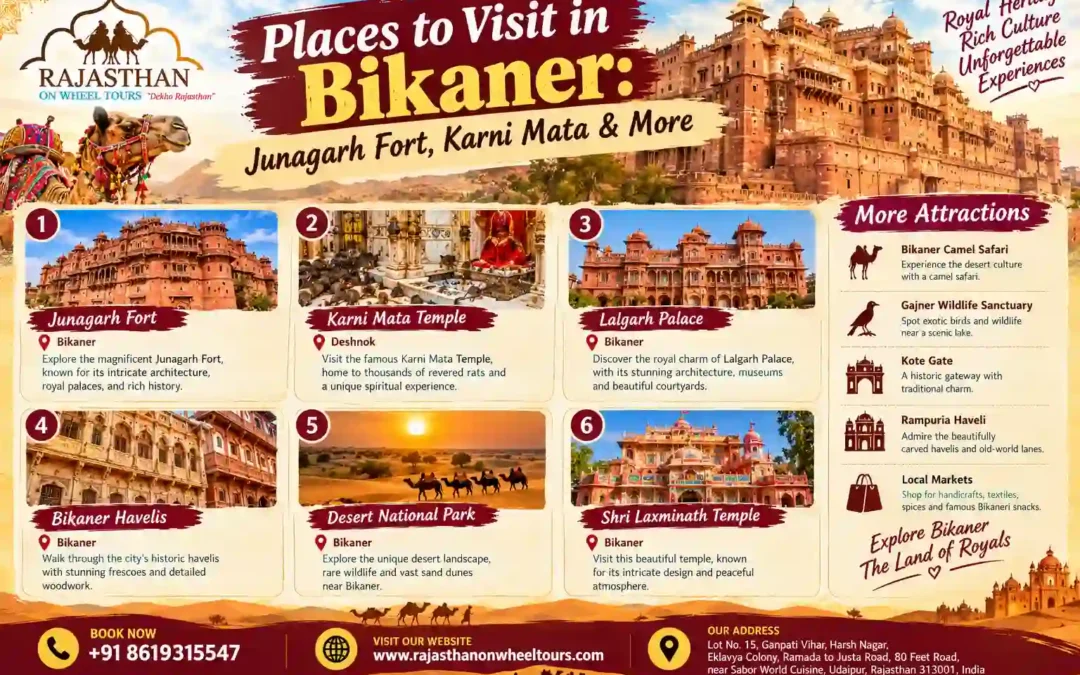
Quick answer: The top places to visit in Bikaner are Junagarh Fort (built 1588–1593, never conquered), the Karni Mata temple at Deshnoke with its thousands of rats, Lalgarh Palace, the National Research Centre on Camel, Gajner Palace and the old city havelis. Two days is ideal; one full day covers the fort, Karni Mata and the camel farm.
Bikaner gets skipped. Most Rajasthan trips run Jaipur, Jodhpur, Jaisalmer, Udaipur and leave it off the map. That’s a mistake. Junagarh has some of the finest palace interiors in the state, the old city feels less touristy than anywhere on the main circuit, and there’s a temple 30 km away unlike anything else in India.
Bikaner at a Glance
| Place | Why go | Time needed |
|---|---|---|
| Junagarh Fort | Palace interiors, never captured | 2–3 hours |
| Karni Mata Temple, Deshnoke | The rat temple | 1–1.5 hours + 45 min drive |
| Lalgarh Palace | Indo-Saracenic palace and museum | 1 hour |
| National Research Centre on Camel | Camel herds, museum, camel-milk café | 1–1.5 hours |
| Old city and havelis | Rampuria havelis, Bhandasar Jain temple | 2 hours |
| Gajner Palace | Lakeside palace and wildlife | Half day |
1. Junagarh Fort
Raja Rai Singh built Junagarh between 1588 and 1593, with his minister Karan Chand overseeing the work. Unlike most Rajasthani forts, it stands on the plains rather than a hilltop, protected instead by a wide moat and thick walls. It was originally called Chintamani and was renamed Junagarh (“old fort”) in the 20th century when the royal family moved to Lalgarh. It’s often said that no enemy ever took it by force.
What makes Junagarh special is inside. Successive rulers added palaces over 300 years, and the interiors are richly decorated, in some ways more so than better-known forts.
Don’t miss:
- Karan Mahal, with gold-leaf painted walls and ceilings
- Anup Mahal, the coronation hall, full of red and gold lacquer work
- Phool Mahal and Chandra Mahal, with mirror work and painted panels
- Badal Mahal, painted with blue clouds and rain, a rare sight in the desert
- Ganga Mahal, with a museum of weapons and a First World War biplane
Timings and tickets: roughly 10 AM to 4:30 PM. Recent fees are around ₹50 for Indian adults and ₹300 for foreign nationals, with student discounts. Guided tours of the inner palaces run in groups. Confirm current rates at the gate.
2. Karni Mata Temple, Deshnoke
About 30 km south of Bikaner, the Karni Mata temple is famous for the thousands of rats, called kabbas, that live inside and are fed and protected. Devotees believe they are reincarnations of the goddess’s followers. Food or drink touched by the rats is considered blessed.
Seeing a white rat is thought to be especially lucky. They’re rare among the brown ones.
The temple’s marble facade and silver doors were added under Maharaja Ganga Singh in the early 20th century.
What to know:
- You walk barefoot, as at any Hindu temple. Some visitors wear socks.
- Shuffle your feet rather than lifting them, so you don’t tread on rats.
- It’s open from early morning to evening; morning and evening aartis are the busiest.
- Entry is free; a camera fee may apply.
It sounds strange, and it is. It’s also a working temple with real devotion, so treat it with respect.
3. Lalgarh Palace
Built between 1902 and 1926 for Maharaja Ganga Singh, Lalgarh is a red sandstone palace mixing Rajput, Mughal and European styles, designed by the British architect Samuel Swinton Jacob. Part of it is now a heritage hotel, and part houses the Shri Sadul Museum, with photographs, hunting trophies and personal items of the royal family.
It’s a good contrast with Junagarh: the same family, 300 years later, living in a very different way.
4. National Research Centre on Camel
About 8 km from the city, this government research centre breeds and studies camels. In the afternoon the herds come back from grazing, which is the best time to visit. There’s a small museum, camel rides, and a parlour selling camel-milk ice cream, kulfi and lassi.
It’s unexpectedly fun, especially with children.
5. The Old City
Bikaner’s old city is a maze of narrow lanes and carved sandstone havelis built by wealthy merchant families.
- Rampuria Havelis: a cluster of red sandstone mansions with intricate carving, mostly seen from the outside.
- Bhandasar Jain Temple: a 15th-century temple with painted interiors and mirror work. Local legend says ghee was mixed into the mortar.
- Kote Gate market: spices, textiles and the city’s famous snacks.
Bikaner is synonymous with bhujia, the crispy gram-flour snack, and with rasgulla. Try both fresh from the shops in the old city.
6. Gajner Palace and Lake
About 30 km west of Bikaner, Gajner was the maharajas’ hunting retreat, built on the edge of a lake. Today it’s a heritage hotel, and the surrounding area is a wildlife sanctuary where you may see blackbuck, nilgai and migratory birds in winter.
It’s a calm half-day or overnight stop if you have time.
Where to Eat in Bikaner
Bikaner is a food city. Some things to look out for:
- Bhujia from the old city shops, eaten fresh and still warm if you can find it
- Kachori for breakfast, with a spicy filling of lentils or onions
- Rasgulla, softer and sweeter than you might expect
- Ghewar, a disc-shaped sweet made in the cooler months and around festivals
- Rajasthani thali with dal-baati, gatte ki sabzi and ker sangri
The area around Kote Gate and the old city lanes has the busiest snack shops. For a sit-down meal, the heritage hotels at Lalgarh and in the city serve Rajasthani dishes in grander surroundings.
Shopping in Bikaner
Look for usta art, the gold-embossed painting style used on camel-hide lamps and boxes, and seen inside Junagarh Fort. You’ll also find woollen carpets and durries, lacquer work, and of course packets of bhujia and sweets to take home.
Best Time to Visit Bikaner
October to March is the time to go. Days are pleasant and nights cold. December and January nights can drop close to freezing, so pack warm layers.
April to June is very hot. Monsoon brings little rain to Bikaner, but humid heat.
The Bikaner Camel Festival, usually held in January, brings camel races, decorated camels, folk music and dance. Check dates in advance.
How Many Days in Bikaner?
- One day: Junagarh Fort in the morning, Karni Mata in the afternoon, the camel centre before sunset.
- Two days: add Lalgarh Palace, the old city havelis and food, and a slower pace.
- Three days: add Gajner, or a desert stay outside the city.
A Two-Day Bikaner Plan
Day 1
- Morning: Junagarh Fort, when it opens, before the groups arrive
- Lunch: Rajasthani thali in the city
- Afternoon: Drive to Deshnoke for the Karni Mata temple
- Late afternoon: National Research Centre on Camel, as the herds return
- Evening: Bhujia and sweets around Kote Gate
Day 2
- Morning: Lalgarh Palace and the Shri Sadul Museum
- Late morning: Old city walk: Rampuria Havelis and Bhandasar Jain Temple
- Afternoon: Gajner Palace and lake, or rest before an onward drive
Fitting Bikaner into a Rajasthan Trip
Bikaner fits naturally between Jaipur or Shekhawati and Jaisalmer, breaking the long desert drive. A common routing is Jaipur → Mandawa → Bikaner → Jaisalmer → Jodhpur.
Our best Rajasthan tour packages include routes through Bikaner, and our 7-day Rajasthan road trip from Delhi shows how a desert loop fits together. If you’re going via Shekhawati, see our Mandawa travel guide.
Call or WhatsApp +91-8619315547 (Udaipur) or +91-9983889373 (Jaipur) to plan a Rajasthan trip with Bikaner on the route.
Planning more of Rajasthan? Browse all our guides on the Rajasthan Travel Blog.
Frequently Asked Questions
1. What are the best places to visit in Bikaner?
Junagarh Fort, the Karni Mata temple at Deshnoke, Lalgarh Palace, the National Research Centre on Camel, the old city havelis and Bhandasar Jain temple, and Gajner Palace.
2. Who built Junagarh Fort?
Raja Rai Singh built Junagarh Fort between 1588 and 1593, with his minister Karan Chand overseeing construction. It was originally called Chintamani.
3. What are the Junagarh Fort timings and ticket price?
It’s generally open from about 10 AM to 4:30 PM. Recent fees are around ₹50 for Indian adults and ₹300 for foreign nationals, with student discounts. Confirm at the gate.
4. Why is Karni Mata temple famous?
It’s home to thousands of rats, called kabbas, which are fed and protected and believed to be reincarnations of the goddess’s devotees. Spotting a white rat is considered very lucky.
5. How far is Karni Mata temple from Bikaner?
The temple is in Deshnoke, about 30 km south of Bikaner, roughly a 45-minute drive.
6. How many days are enough for Bikaner?
One full day covers the main sights. Two days lets you add Lalgarh Palace, the old city and its food at a relaxed pace.
7. What is the best time to visit Bikaner?
October to March, when the weather is pleasant. The Bikaner Camel Festival is usually held in January.
8. What food is Bikaner famous for?
Bikaneri bhujia, the crispy gram-flour snack, is the city’s best-known food. Rasgulla and other sweets from the old city are also popular.
9. Is the camel research centre in Bikaner worth visiting?
Yes, especially in the late afternoon when the camel herds return. You can see different breeds, visit the small museum and try camel-milk ice cream.
10. Can Bikaner be combined with Jaisalmer?
Yes. Bikaner sits on the route between Jaipur or Shekhawati and Jaisalmer, and many Rajasthan itineraries stop there on the way to the desert.