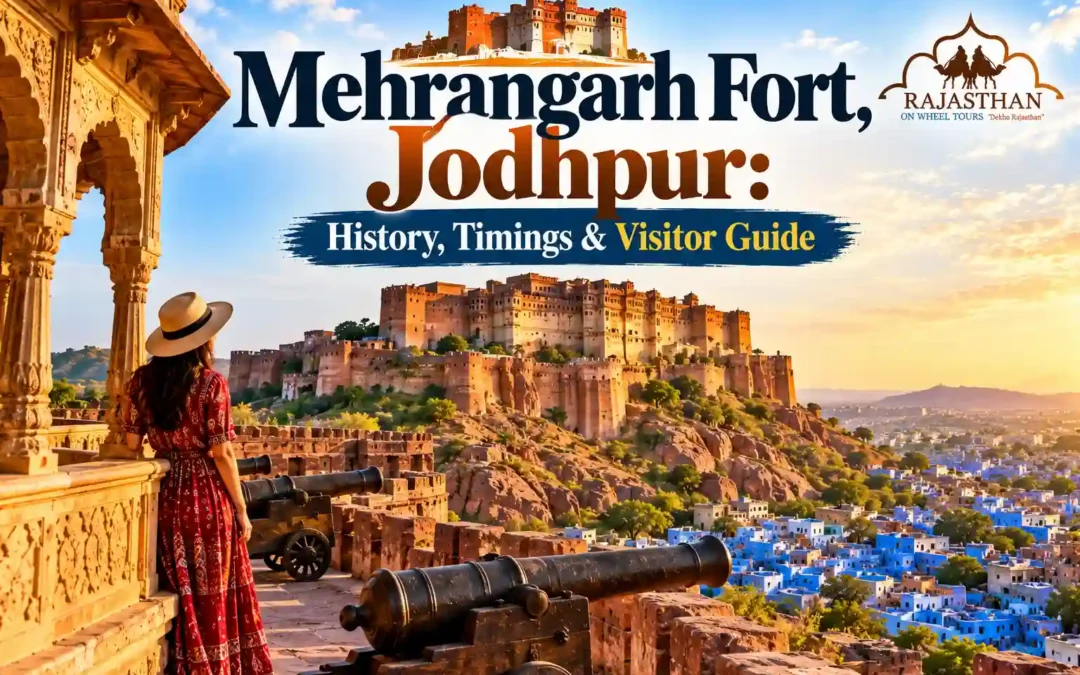
Quick answer: Mehrangarh Fort was founded in 1459 by Rao Jodha, the Rathore ruler who also founded Jodhpur. It stands on a rocky hill about 125 m above the Blue City and is one of the largest and best-preserved forts in India. Inside are ornate palaces, a superb museum and sweeping views. It’s open about 9 AM to 5 PM daily; tickets are roughly ₹200 for Indian visitors and ₹800 for foreign visitors, with the audio guide and lift extra. Allow 3 to 4 hours.
Jodhpur is one of those rare cities where the main sight is visible from almost everywhere. Mehrangarh rises straight out of the rock, its walls so sheer they seem to grow from the cliff. Below, the old city spills out in a maze of blue houses. Inside, the palaces are some of the most beautiful rooms in Rajasthan. Rudyard Kipling reportedly called it the work of “angels, fairies and giants,” and it’s hard to disagree.
Mehrangarh Fort at a Glance
| Item | Details |
|---|---|
| Founded | 1459 by Rao Jodha (Rathore dynasty) |
| Location | Rocky hill above the old city, Jodhpur |
| Height | About 125 m (410 ft) above the city |
| Managed by | Mehrangarh Museum Trust |
| Timings | About 9:00 AM – 5:00 PM daily |
| Ticket (approx.) | ₹200 Indian visitors; ₹800 foreign visitors; student and senior concessions |
| Extras | Audio guide (about ₹180), lift (about ₹50 one way) |
| Time needed | 3 – 4 hours |
| Nearby | Jaswant Thada, Rao Jodha Desert Rock Park, Chokelao Bagh |
Ticket prices are set by the museum trust and change from time to time. Check at the counter or on the official Mehrangarh website.
History of Mehrangarh Fort
In 1459, Rao Jodha, chief of the Rathore clan, decided his old capital at Mandore was no longer safe. He chose a steep rocky hill a few kilometres south, known locally as Bhaurcheeria, the “mountain of birds,” and began building a new fort. The city that grew beneath it was named Jodhpur after him.
Legend says a hermit living on the hill cursed the new fort with drought when he was forced to leave. To lift the curse, a man named Rajaram Meghwal is said to have agreed to be buried alive in the foundations. His descendants were granted land in return, and a plaque inside the fort still remembers him.
Over the next five centuries, Rathore rulers kept adding to the fort. The walls reach up to around 36 m high and 21 m thick in places. The palaces inside date mostly from the 17th to 19th centuries. Mehrangarh was never taken by direct assault, and today it’s run by the Mehrangarh Museum Trust, set up by the former royal family, which has made it one of the best-managed monuments in India.
The Seven Gates
You climb into the fort through a series of gates, each with its own story:
- Jai Pol (“Victory Gate”): The main entrance, built by Maharaja Man Singh in the early 1800s to mark victories over Jaipur and Bikaner.
- Fateh Pol: Built by Maharaja Ajit Singh in the early 18th century after recovering Jodhpur from the Mughals.
- Dedh Kamgra Pol: Still marked by cannonball scars from past sieges.
- Loha Pol: The final gate. Beside it are the small sati handprints of royal widows who died on their husbands’ funeral pyres, a sobering reminder of the past.
Look for the sharp bends in the approach road, designed to stop elephants from building up speed against the doors.
What to See Inside Mehrangarh Fort
Moti Mahal (Pearl Palace)
The largest of the palace rooms, built in the 17th century as a hall of private audience. The walls are polished with a lime plaster finish that shines like pearl, and five hidden balconies allowed the queens to watch court proceedings unseen.
Phool Mahal (Flower Palace)
An 18th-century pleasure hall, possibly the most lavish room in the fort, with gold filigree ceilings, painted walls, and portraits of Rathore rulers and ragamala paintings. It was used for dance and music performances.
Sheesh Mahal (Mirror Palace)
A glittering room covered in small mirror pieces set into the walls and ceiling, with religious images painted among them. It’s small, so you may have to wait for a moment alone.
Takhat Vilas
The private chamber of Maharaja Takhat Singh in the 19th century, with a wooden ceiling hung with Christmas-tree baubles, murals of dancers and Krishna, and a blend of traditional and European touches.
Jhanki Mahal
A long corridor of latticed windows from which the royal women watched the courtyard below. It now displays a collection of royal cradles.
The museum galleries
Mehrangarh’s museum is one of the finest in Rajasthan. Don’t rush it.
- Howdah gallery: Silver and gold elephant seats, including one said to have been gifted by the Mughal emperor Shah Jahan.
- Palki gallery: Royal palanquins, including a domed one captured in battle.
- Daulat Khana: Mughal-era treasures, textiles and decorative arts.
- Armoury: Swords, shields, guns and daggers, some with jade and gold handles.
- Painting gallery: Jodhpur school miniatures.
- Turban gallery: A colourful display of the many turban styles of Rajasthan.
Chamunda Mataji Temple
At the southern end of the fort is the temple of Chamunda Devi, the family deity of the Rathores, brought here by Rao Jodha from Mandore. It’s especially busy during Navratri.
The ramparts and cannons
Walk the ramparts along the western side for the classic view of the Blue City: thousands of indigo-washed houses spread out below. Old cannons still point out over the walls. Late afternoon light is best.
Around the Fort
Jaswant Thada
About a kilometre from the fort, this white marble cenotaph was built in 1899 in memory of Maharaja Jaswant Singh II. The marble is so thin in places that it glows when the sun shines through it. There’s a small lake, carved jharokhas and portraits of the Jodhpur rulers. A separate ticket applies. Allow 30–45 minutes.
Rao Jodha Desert Rock Park
Just below the fort walls, this park restores the natural desert ecology of the rocky hill with native plants. Walking trails wind through volcanic rock formations, with beautiful views of the fort. Go in the early morning or late afternoon.
Chokelao Bagh
A restored 18th-century garden inside the fort complex, with a restaurant overlooking the city. A good place for a break, or dinner as the fort lights up.
Zipline
A zipline course runs across the fort’s northern walls and lakes, giving an unusual bird’s-eye view of Mehrangarh. It’s popular with families and teenagers. Book ahead in peak season.
A Suggested Visit (3–4 Hours)
- 9:00 AM: Arrive at opening time. Collect your audio guide.
- Climb through the gates (or take the lift if you prefer).
- Palaces: Moti Mahal, Phool Mahal, Sheesh Mahal, Takhat Vilas.
- Museum galleries: Howdahs, palanquins, armoury, paintings.
- Ramparts: Blue City views and the cannons.
- Chamunda Mataji Temple.
- Lunch at Chokelao Bagh or back in town.
- Afternoon: Jaswant Thada and the Rock Park.
Tips for Visiting Mehrangarh
- Take the audio guide. It’s one of the best in India, with stories narrated by members of the royal family.
- Arrive early to avoid tour groups and midday heat.
- Wear good shoes. The ramps and steps are steep.
- Use the lift if needed. It’s a good option for older travellers and families with young children.
- Look for the musicians. Folk musicians often play in the courtyards; a small tip is appreciated.
- See it lit up. The fort looks magical at night from the old city, or from a rooftop restaurant.
Best Time to Visit
- October to March: Best, with pleasant weather for the climb and the ramparts.
- October: The Marwar Festival around the Sharad Purnima full moon, and the Rajasthan International Folk Festival (RIFF) held at the fort in some years, bring music and dance to Mehrangarh.
- April to June: Very hot. Visit at opening time and head indoors to the galleries before noon.
- July to September: Humid with occasional showers, but fewer visitors.
How to Reach Mehrangarh
The fort is about 5 km from Jodhpur railway station and around 10 km from the airport. Autos and taxis go up to the main gate; the old city’s lanes are narrow, so a car with a local driver is easiest.
Getting to Jodhpur:
- From Udaipur: About 250 km, 5 to 6 hours, often via Ranakpur’s Jain temple.
- From Jaipur: About 340 km, 6 hours by road, or by train.
- From Jaisalmer: About 285 km. See our Jodhpur to Jaisalmer road trip guide.
Beyond the Fort
Spend at least a day in Jodhpur. Our guide to places to visit in Jodhpur covers Umaid Bhawan Palace, the clock tower market and more. For rural Marwar, a morning Bishnoi village safari is a great addition. Heading west next? Compare Mehrangarh with the living fort in our Jaisalmer Fort guide.
Plan Your Jodhpur Trip
We run private cars to Jodhpur from Udaipur and Jaipur, and on to Jaisalmer. See our Udaipur to Jodhpur taxi service, or call us to plan a western Rajasthan route.
Call or WhatsApp +91-8619315547.
Planning more of Rajasthan? Browse all our guides on the Rajasthan Travel Blog.
Frequently Asked Questions
1. Who built Mehrangarh Fort?
Mehrangarh Fort was founded in 1459 by Rao Jodha, the Rathore ruler who also founded the city of Jodhpur. Later rulers added most of the palaces between the 17th and 19th centuries.
2. What is the Mehrangarh Fort ticket price?
Tickets cost roughly ₹200 for Indian visitors and ₹800 for foreign visitors, with concessions for students and seniors. The audio guide and lift cost extra. Prices can change, so check at the counter.
3. What are the Mehrangarh Fort timings?
Mehrangarh Fort is usually open from about 9 AM to 5 PM every day. Arrive at opening time to avoid crowds and the midday heat.
4. How much time is needed to visit Mehrangarh Fort?
Allow 3 to 4 hours for the palaces, museum galleries and ramparts. Add an hour or two for Jaswant Thada and the Rao Jodha Desert Rock Park nearby.
5. Is there a lift at Mehrangarh Fort?
Yes. A lift takes visitors up to the main palace level for a small fee, which is helpful for older travellers and families with young children.
6. Is the Mehrangarh audio guide worth it?
Yes. The audio guide is excellent, with detailed stories about the palaces, the rulers and the museum collection. It’s one of the best audio guides at any Indian monument.
7. What is Jaswant Thada?
Jaswant Thada is a white marble cenotaph built in 1899 in memory of Maharaja Jaswant Singh II. It’s about a kilometre from Mehrangarh Fort and has a separate entry ticket.
8. Why is Jodhpur called the Blue City?
Many houses in Jodhpur’s old city are painted blue. The tradition is often linked to Brahmin households and to keeping homes cool. The best view of the blue houses is from Mehrangarh’s ramparts.
9. Can I do a zipline at Mehrangarh Fort?
Yes. A zipline course runs over the fort’s walls and lakes on the northern side. It’s popular, so booking ahead is a good idea in peak season.
10. What is the best time to visit Mehrangarh Fort?
October to March is the most comfortable time. October also brings the Marwar Festival and, in some years, the Rajasthan International Folk Festival, held at the fort.